This is the second investment memorandum for a fund managed by Bel Air Asset Management Co., Ltd. since its establishment in 2018. In this memorandum, I will first introduce the operations of the company we have focused on over the past year, secondly, we will focus on discussing Ping An of China, and finally we will briefly share some of our views on current macro challenges. I hope that through this communication, investors can better understand our investment style, recognize our investment methods, agree with our long-term perspective, and at the same time realize our limitations.
According to the compliance requirements of private equity funds, this article will not display the positions and performance of the company's products, but will only serve as an exchange of investment strategies and experiences.
1. Business situation
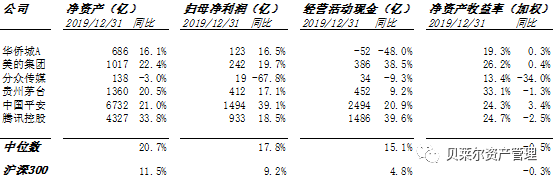
Instead of focusing on short-term fluctuations in stock prices, we prefer to examine the changes in the company's intrinsic value each year under different economic conditions. The following table lists the companies we focused on last year (please refer to the 2018 investment memorandum) and some of their key operating data over the past year.
Figure 1. Operating data of companies we focus on and companies in the Shanghai and Shenzhen 300 Index
Data source: Annual report of listed companies
Note: This list does not represent a company's position or recommendation
From Figure 1, we can see that the company's net assets, net profit attributable to shareholders of the parent company and cash flow from operating activities increased by 20.7%, 17.8% and 15.1% respectively (median), and the weighted return on equity fell by 0.5%. During the same period, the net assets, net profit attributable to shareholders of the parent company and cash flow from operating activities of the Shanghai and Shenzhen 300 Index increased by 11.5%, 9.2% and 4.8% respectively (median), and the weighted return on equity fell by 0.3%.
Careful readers can find that these six companies are no different from the six companies we gave at the end of our 2018 investment memorandum. However, the overall stock market improved significantly in 2019, with major indices rising significantly. Haven't we made major adjustments all year? First, we believe that the companies we focus on have huge potential and that they provide products or services that are rare, competitive, and even desirable in the market. As China's economy continues to grow and people's yearning for a better life continues to increase, the value of these companies has considerable potential to continue to increase in the next few years. We don't have any pressure to make short-term actions, even if the prices of some companies increase (or fall) significantly because of Mr. Market's sentiments or preferences. We and our investors are firm long-term activists. We do not bear the costs of leverage due to debt or the use of complex derivative instruments. Time will always be our friend. In addition, value investors should not sell often, and excellent investment opportunities are very rare. Review the three dimensions of our focus mentioned in the previous memo:
1. There is a good margin of safety in terms of price;
2. Have long-term competitive advantages;
3. Management with both ability and political integrity.
In a short period of time (such as one year), there are very few companies that can meet all three dimensions at the same time. Even the companies we focus on often fail to meet one or even occasionally multiple of these dimensions. Most of the time, there are few companies in the market that can satisfy the second and third dimensions often make people shy away from them in the first dimension. In last year's memorandum, we focused on Ping An of China, so let's take a specific look at some changes in Ping An of China over the past year.
2. Safe China
According to Ping An's annual report of China, in 2019, Ping An's operating profit attributable to shareholders of the parent company of China was 132.955 billion yuan, a year-on-year increase of 18.1%, and its operating ROE was 21.7%(2018: 21.9%). Looking at different departments,
The life insurance and health insurance business, which accounted for the largest proportion, achieved operating profit of 88.950 billion yuan, a year-on-year increase of 24.7%. The new business value ratio reached 47.3%, a year-on-year increase of 3.6 percentage points. The new business value ratio of agent channels was 64.9%, a year-on-year increase of 7.8 percentage points. The per capita new business value of agent increased by 16.4% year-on-year.
Property and casualty insurance achieved operating profit of 20.952 billion yuan, a year-on-year increase of 70.7%. The comprehensive cost ratio remains at the industry-leading position of 96.4%(96% in 2018);
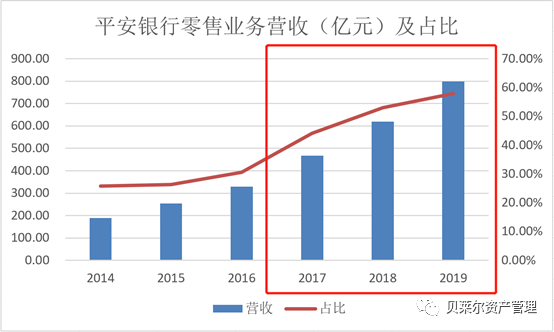
Ping An Bank achieved a net profit of 28.195 billion yuan, a year-on-year increase of 13.6%. Among them, retail business operating income and net profit increased by 29.2% and 13.8% respectively year-on-year, accounting for 58.0% and 69.1% respectively.
If the impact of income tax reductions is excluded, life insurance pre-tax operating profit increased by 2.6%. Some people find this near-stagnant performance unacceptable, but we disagree. The economy has cycles and performance fluctuates. Low growth (or decline) in a certain year does not mean that the ceiling of the insurance market has reached or that the company is no longer competitive (such as Moutai in 2013 and Gree in 2015). On the contrary, from the huge increase in the value of new business, we can see that Ping An Company of China was not affected by the aggressive pricing of some competitors in the industry, but insisted on a long-term perspective and sold more long-term high-value policies during this period. From the decline in the number of agents and the huge increase in the per capita output value of agents, we see the company's firm determination to reform life insurance. Can you imagine a listed company proactively pushing for changes that immediately caused revenue to decline? The managers of most listed companies want to report beautiful numbers every quarter at all costs (maybe not that big, sometimes as long as a fine of 600,000 yuan), China Ping An's management may be concerned about the situation a year or even several years from now. Such management concepts are long-term competitive advantages that cannot be replicated.
Charlie Munger, Berkshire's vice chairman, once said,"If I want to have an opinion, if I can't prove myself better than the smartest, most capable, and most qualified people in the world to refute that opinion, I don't deserve it." Let's borrow this reverse thinking to sort out and discuss some key logics for "not optimistic" about Ping An.
1) As interest rates continue to decline, the investment income of insurance companies (mainly life insurance) will drop significantly;
2) Ping An's sales staff often mislead or even deceive policyholders, and such insurance companies are not trustworthy;
3) Internet thinking insurance companies/platforms such as Mutual Treasure, Micro Medical Insurance, Zhong 'an, and Huizai stole away the business that originally belonged to Ping An;
4) Senior core management personnel have left one after another, and Ping An's management has major problems.
Among them, 1) it is a question about the investment side, 2) it is about the company's illegal sales, 3) it is the relatively little-discussed but perhaps the most terrible blow to the dimension reduction, and 4) it involves company management. Let's go into detail one by one:
(1) Investment end
As China's economic growth (GDP) continues to decline recently and global economic pressure is gradually increasing, global interest rates, including China's interest rates, have a clear downward trend. The market expects this downward trend to be unilateral and permanent. Viewed from a minimalist insurance business model, this problem seems to be extremely big: on the one hand, the debt side sells insurance products with higher expected returns (such as 4%), while on the other hand, the investment side can only achieve lower returns (such as 3%) due to falling interest rates. Every time we go in and out, we have lost money before counting the expenses. Is this business still meaningful? We do not make any macro predictions here, just assume that if such a relatively unfavorable situation is really, interest rates will continue to fall in the future to see what will happen.
First of all, the downward trend in interest rates has an impact on Ping An, but this impact is not severe and rapid. On the contrary, it is mild and slow. Although Ping An's investment assets of China have exceeded 3 trillion yuan, most of them have been invested, and all when interest rates are relatively high. To put it simply, the investment side has locked in a portfolio with higher returns (such as 5%), which is enough to cope with the expected return on the debt side (such as 4%).
There is still a small problem here. The debt side has long maturities (life insurance has long average compensation and expense life cycles), while the asset side has short maturities (such as ten-year treasury bonds), and assets that mature early face reinvestment risks. As interest rates continue to fall, after the asset-side funds mature, they find that high-yield bonds cannot be found, so they can only invest in bonds with relatively low returns. Although this risk cannot be completely eliminated, it can be effectively mitigated, such as lengthening the asset side cycle (8 years, or even 10 years +) to make it as close as possible to the debt side cycle, and at the same time increasing efforts to allocate high dividends and low valuations. High-quality equity assets. In fact, Ping An Company of China has also done the same. On the one hand, it has lengthened the duration of the asset side, and on the other hand, it has vigorously allocated long-term, relatively high-yield high-quality bonds, bank capital bonds, perpetual bonds, as well as domestic A-shares and Hong Kong stocks with high dividends and low valuations.
In addition, what about the new policies and the new premiums brought by old policies every year? They will also face an investment environment with low interest rates. Since the overall risk-free interest rate or government bond interest rate are falling, the overall market investment return will also decline, and the liability side of insurance products will also make certain adjustments accordingly, such as the expected return being reduced from 4% to 3%. In August 2019, the China Banking and Insurance Regulatory Commission issued a policy to lower the upper limit of the predetermined interest rate from 4.025% to 3.5%.
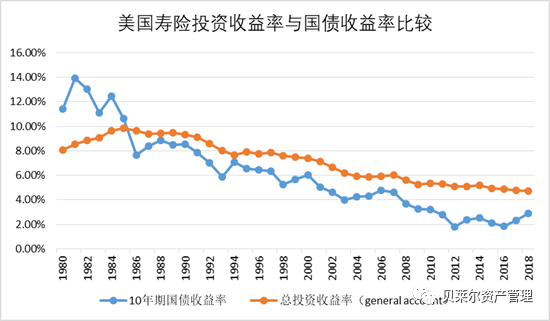
We can also compare our foreign counterparts. After all, they have all experienced ultra-long periods of downward interest rates. Let's take a look at their response and performance in the environment at that time.
Figure 2. Comparison of investment yields of U.S. life insurance companies and treasury bonds yields
Data source: American Life Insurance Association
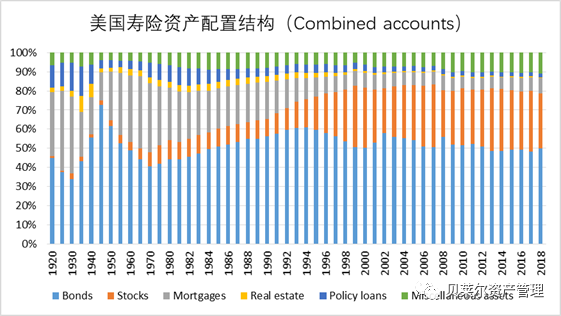
Figure 3. Investment asset allocation structure of US life insurance companies
Data source: American Life Insurance Association
As can be seen from the above figure, since 1980, the United States has experienced a ultra-long period of continuous decline in interest rates, and the ten-year treasury bond has dropped from 11.4% to 2.9%. Life insurance companies in the United States also continue to be negatively affected, but by continuously increasing the proportion of stock assets and interest-rate bonds, their total investment yield has slowly dropped from 8% to 4.75% in 38 years (an average annual decline of 0.09%). It can be seen that the magnitude and speed of such a decline are much smaller than the drastic changes in government bond interest rates. Considering the span of nearly 40 years, the process can also be said to be mild and slow.
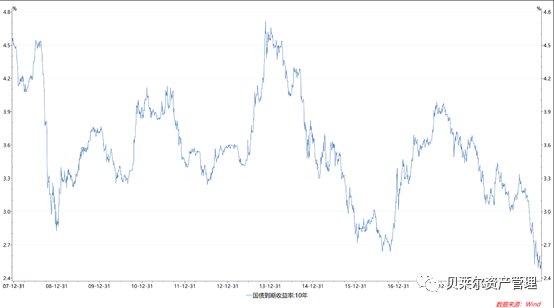
Figure 4. Treasury bond yields over the past ten years
Data source: Wind data
Looking back at my country, although the yield of 10-year treasury bonds has continued to decline since 2018, it has not remained at a high level in the past ten years, but has fluctuated between 2.5% and 4.8%. Among them, there has also been a steep drop from 4.7% at the end of 13 to 2.7% at the end of 16. During this period of rapid decline in interest rates, Ping An of China maintained a good investment yield (the total investment yield from 2014 to 2016 was 5.1%, 7.8% and 5.3% respectively), but it still revised downward the assumption of long-term investment yield at the end of 2016 to be cautious, which finally led to a one-time drop in the company's embedded value of 42.1 billion that year (equivalent to 6.6% of the embedded value of 637.7 billion that year).
Therefore, no matter from the business model, foreign counterparts or our own history, the decline in interest rates will have a certain impact, but the extent can be completely controlled.
(2) Illegal sales
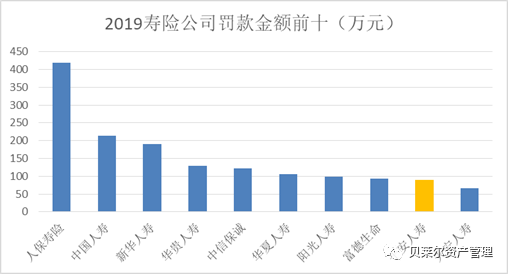
At present, there are many rumors in the market about Ping An's illegal recruitment and illegal sales by China. Last year's annual report of Ping An Company of China also revealed that surrenders did increase. With this question in mind, we investigated the penalties and amounts of fines imposed by China Banking and Insurance Regulatory Commission on major life insurance companies. As can be seen from the figure, Ping An Company of China, which has a huge size, only ranked ninth in terms of fines for illegal sales in the past year, far less than other competitors of the same size.
Although it is already better than its peers, there is still room for improvement. We must realize that a highly motivational culture is a double-edged sword. Wells Fargo, a leader in the U.S. banking industry, fell into a scandal that harmed customers 'interests because its high-pressure sales targeting culture crushed the moral bottom line of its employees, eventually leading to the resignation of two chief executives and billions of dollars in fines. Reputation is an insurance company's most important asset.
Figure 5. Fines from life insurance companies in 2019
Data source: China Insurance Regulatory Commission
(3) Reduction of dimensions
Among all the unfavorable logics, dimension reduction strikes are the least likely, but the greatest threat. For long-term value investors, once it happens, the destructive power can be devastating (cars are to carriages, apples are to Nokia). First of all, we must understand the commercial nature of the insurance industry, that is, the various products provided by players in the industry are not particularly different from each other (especially property insurance). The products and services of any insurance company can easily be copied and copied. In fact, for a long time, in mature overseas markets, companies in various regions have done this. Insurance companies do not have Coca-Cola's exclusive formula, Microsoft's technology patents, or the geographical advantage of Chishui River. Its core competitive advantages come more from how management controls costs (such as low comprehensive cost ratio for property insurance) and how to price (reasonably setting policy prices and expected returns). For example, GEICO continues to expand its share in the U.S. auto insurance market based on its low-cost operating advantages. The Internet business model led by Mutual Treasure/Micro Medical Insurance/Zhongan Insurance avoids the huge team of agents and directly faces users, naturally having a low-cost advantage.
Among them, the mutual treasure under Alipay is the most eye-catching. Mutual Bao's operating rate is 8% of the insured amount, while traditional operating rates are measured at 15-20% premium income rates. According to data, the number of mutual treasure users less than two years after its establishment has exceeded 100 million. The actual shared cost for users in 2019 was only 29.17 yuan, which seems to be a huge advantage compared to the average annual cost of most critical illness insurances, which often cost hundreds or thousands. Has this business model and such achievements already constituted a blow to the traditional insurance industry? Taking a closer look, we found that
Among the 100 million members of Mutual Treasure, one-third are from rural areas and counties, and nearly 60% are from third-tier cities and below;
The advantage of mutual treasure is that the price is extremely low (at present), but the insurance amount is also very low. The maximum compensation for serious illness before the age of 40 can be 300,000 yuan, but after the age of 40 (when protection is more needed), the maximum compensation is only 100,000 yuan;
The payment process is long. As shown in last year's waiting list, a member was confirmed to have a serious illness on September 10, but entered the formula list in December and payment did not begin (payment is expected to be made only in January), which means that the actual waiting period exceeds 3 months, much higher than similar traditional insurance company products. As the number of participants rises rapidly, mutual treasure's review and post-service teams seem to be a bit out of touch;
The growth of the number of people has slowed down. Due to the significant increase in the amount apportioned from the previous period, it is reported that 300,000 people have chosen to retire in December 2019. Some of the audiences we interviewed said they could still accept the current assessment, but would choose to withdraw if there was a further significant increase. They think that on the one hand, they have not paid much money before, and on the other hand, they feel that they are in relatively healthy health. This kind of continuous spending feels like helping the elderly or infirm share the medical expenses.
As mentioned above, the repayment cycle and guarantee amount of Mutual Treasure may be difficult to meet the urgent needs of seriously ill patients. This model of mutual treasure is more like a double-edged sword. First of all, it is easy for customers to come in and go out, and the conversion cost is low. Secondly, mutual welfare products cannot avoid issues such as "transparency, fairness, and corruption". Although "mutual treasure" has made great improvements compared with similar mutual aid products, including list publicity and the introduction of a jury system, the recent rapid increase in the amount of assessed contributions has also aroused many doubts and many negative articles ("gambling","high management fees") have appeared. Finally, a model that focuses on public welfare also means that commercial elements are diluted, making it difficult to encourage management and support teams to provide active and high-quality services. Mutual Bao itself seems to be aware of this problem, so it is actively diverting members to take out their own commercial insurance. From this perspective, compared with traditional insurance companies, mutual treasure is more like a competitor with "innovation channels".
For Internet insurance companies/platforms such as Micro Medical Insurance, Good Medical Insurance, Zhongan Insurance, Huize and Shuidi Mall, we believe that they will encounter one or more of the following challenges,
Consumers 'choice of long-term financial services such as insurance and banking is based on their trust in brands and companies. Emerging platforms (such as Huize and Shuidi) that lack long-term operating history and strong financial background may find it difficult to provide consumers with a sense of security to carry long-term funds;
The lack of exclusive and convenient one-to-one services on Internet platforms is easy to cause misunderstanding (and in some cases may be misleading). For example, some Internet celebrity products have million-dollar medical insurances, because they do not come with a guarantee renewal clause, which attracts complaints from customers after the product is stopped or the customer is seriously ill. A high-quality agent team can help answer doubts and eliminate troubles and effectively strengthen this trust;
At present, my country's middle class has increased significantly, and the standardized products provided by online platforms may not be able to meet the needs of consumption upgrades. A high-quality agent team can provide personalized services, which is particularly important for the future consumption trend that places more emphasis on services;
Long-term life insurance/health insurance products are different from production-line products such as automobile insurance. The latter is compulsory consumption (the law stipulates that you cannot go on the road without automobile insurance) and consumers will take the initiative to purchase. However, the former is anti-human consumption. It emphasizes delayed enjoyment and requires consumers to save for future needs. This may be incompatible with the model of our new generation, who prefer to mortgage the future for immediate rights. Such ideological gaps often require a certain amount of external force to close them.
It is undeniable that Internet insurance (especially Mutual Insurance) has provided certain protection for many low-income people because of its low price and low threshold, and has gradually cultivated their insurance awareness. Human beings are inherently mutually beneficial. With the steady growth of per capita disposable income in my country, the gradual rise in medical expenses, and the continuous improvement of insurance awareness, these users are more likely to choose and purchase on the platform they have trusted for many years. More comprehensive and higher-security commercial insurance. This special "channel advantage" established by Internet platform companies is estimated to be difficult for other competitors to imitate or catch up with in a short period of time. For the insurance industry, they can be said to not only popularize insurance knowledge, but also increase insurance penetration, bringing long-term benefits that may be higher than short-term threats. For Ping An of China, these platforms will be strong competitors that they have to face for the foreseeable period of time in the future.
(4) Company management
"Well-adapted species do not originate from the instinct of creation specially endowed by heaven, but because of the multiple small effects of a universal law, which causes the evolution of all living things, that is, proliferation and change, allowing the strongest to survive and the weakest to die."
--Darwin's The Origin of Species
Enterprises, without doubt, are also a species that needs to evolve. An enterprise that can last forever must set up a mechanism to stimulate internal progress and bring out the potential and passion of its members, otherwise it will easily fall into rigidity and stagnation. According to data, like Huawei and Tencent, Ping An likes to do horse racing. We believe that this system is especially important for large companies, which can break down bureaucracy, avoid laziness and laxity in human nature, and guide a proactive mentality.
Cai Fangfang, CHO of Ping An Group, mentioned in an exclusive interview with "China Entrepreneur" magazine,"There are two models in Ping An's horse racing system: one is to rank individuals; the other is to rank among businesses, and we will also set up multiple teams to compete together. In this case, it cannot be said that there is no redundancy. It could have been done by one team, but there were several more teams to compete with each other. I think in this case, the horse racing system itself is a manifestation of a high-performance model. People may not be able to run fast by themselves, but someone running next to them will stimulate their potential and be higher, faster and stronger. When it comes to internal friction, if we do not adopt a horse racing system or a highly competitive elimination mechanism, the internal friction will be more, because seniority, a big pot, and free riding will soon occur, or some people will sit there and not work. There is no way to win him down. The internal friction generated in this situation is invisible, and young people will have no chance." At first glance, such a model seems a bit cruel. In fact, many companies in business history that are good at long-distance running do not have a comfortable and relaxed working environment. This is like running a marathon. It is already very difficult to finish the race. It is naturally impossible to win the championship if the process is easy and easy.
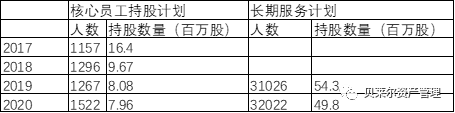
However, such a culture does not mean that the company treats its employees severely. On the contrary, Ping An actively rewards hard-working employees through different employee stock ownership, long-term service and other plans. Such a mechanism not only strengthens the long-term binding of company interests and employee interests, but also ensures that employees promote the company's sustainable development, share benefits and risks, and create long-term and sustainable value for shareholders. You should know that P & G, which first did this (launched an employee shareholding plan in 1892), is still one of the greatest companies in the world. During our chat with some Ping An employees of China, we also found that although the front-line salesmen would more or less talk about the pressure of assessment, they were all full of passion and motivation.
Figure 6. Ping An employee stock ownership plan and long-term service plan of China
Data source: Ping An Annual Report of China
We believe that the system and culture are higher than leaders in management, but it does not mean that the company's executives are not important. If a large ship with hundreds of thousands of employees and trillions of assets is to ride the wind and waves in the sea and always maintain a leading position, the captain (or captains) will inevitably exert a great influence. A more critical question is, how are they trained and selected?
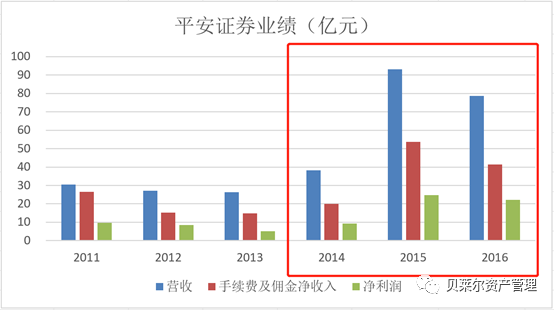
Ping An's top management in China has an extraordinary history, and Xie Yonglin, the newly promoted general manager, is no exception. As a veteran employee of Ping An in the earliest days, Xie entered Ping An in 1994 and has reached the highest level today from the grassroots level. In 2013, Xie was ordered to join Ping An Securities in the face of danger. During his three years in office, he reversed the continuous decline in Ping An Securities 'performance for many years. In 2016, Xie was once again appointed to join Ping An Bank in the face of crisis and carried out drastic reforms with an unbroken mindset. Three years later, Xie not only achieved remarkable results, but also successfully transformed Ping An Bank into a highly competitive retail bank.
Figure 7. Main performance data of Ping An Securities (red box shows after Xie became the owner)
Data source: Ping An Annual Report of China
Figure 8. Ping An Bank's retail business operating data (red box shows after Xie became the owner)
Data source: Ping An Annual Report of China
Xie Neng started from the lowest level and rotated the management of multiple subsidiaries step by step to be promoted to general manager today. This development and planning benefit from Ping An's long perspective. As far as we know, many senior talents of Ping An Company have accumulated valuable management and leadership experience through similar rotation experiences in key positions. Huawei and Alibaba, which have long-term competitive advantages, both have similar mechanisms. This arrangement helps break the burnout of staying in your place for a long time, stimulates continuous learning and gains leadership improvements beyond current business. Only a very small number of companies with ultra-long-term thinking and huge resources will evolve this culture.
Please note that we are not arguing that Xie will make great progress as always, or that Ping An of China will perform exceptionally during Xie's tenure as general manager. Of course, we hope this will be the case. What we are more concerned about is Ping An's talent system in China, including training, promotion, reserve, echelon, etc. You know, no matter how bright a star is, there will be a day when it dies, but Hollywood can never end. At present, in this regard, to say the least, Ping An of China far exceeds its main competitor in the market.
3. Current challenges-Sino-US trade conflicts
As we all know, we are currently facing unprecedented challenges in two areas: the Sino-US trade conflict and the new coronavirus pneumonia epidemic.
As value investors, we are only good at bottom-up company and industry analysis. Obviously, two macro topics of this magnitude have far exceeded our ability circle. However, they are like an inseparable boulder, landing in the middle of the path that almost all investors must have to go through. Although we should strive to expand our sphere of capabilities, after searching a lot of historical data and reading some related books, we have not been able to produce a certain expectation even on the economic issue of Sino-US trade (in fact, economics itself is an extremely inaccurate subject). Not to mention the COVID-19 epidemic involving biology, medicine, immunology, public health and other disciplines. What is more complicated is that the possibility and development of these events have spawned multiple paths, and there is a huge gap between the optimistic path and the pessimistic path. In this case, making any definitive choice would entail huge risks by staying away from other paths.
Those who know do not speak, but those who speak do not know. -- "Lao Tzu·Chapter 56"
Here we do not make any predictions about the future, nor do we make any definite judgments. We will only talk about our views on the topic of Sino-US trade conflicts, hoping to bring some inspiration to readers. This topic will be divided into three parts. We will discuss why this trade conflict, which is widely considered impossible, occurred, how we should respond to it, and what the worst could be.
1. Why did this trade conflict occur that neither China and the United States seem to want to see?
This trade conflict that began in 2018 was not only unexpected to China, but even many groups in the United States did not understand it. In fact, few people expected this trade dispute to occur, and no one expected it to last so long. This sudden black swan caused the stock markets of both sides to experience varying degrees of decline (although China's A-share market rebounded a lot in 19 years, it once fell by a quarter at its peak). At the beginning, the mainstream view judged that the United States could not do such a thing as harming the enemy and injuring itself. U.S. business organizations and companies have also warned that tariffs will increase costs for U.S. consumers and risk triggering a disruptive trade war. Even Paul Krugman, a Nobel Prize-winning economist in the field of trade in the United States, expressed strong opposition. He wrote in the New York Times that a trade war would harm but not benefit, and everyone would suffer economic losses. However, this is how the black swan of the trade war spread its huge wings despite various predictions that it was impossible.
Why is this happening? Why do decision-makers turn a blind eye to the advice of these professionals? How was this unilateral protective tariff introduced? American economic historian Douglas Owen said in "The Conflict of Trade" that "in American history, the forces supporting and opposing high tariffs have always been disproportionate." He went on to quote the view of political scientist Schatzschneider in his 1935 book "Politics, Pressure and Tariffs" that "the costs of high tariffs are spread among a wide range of groups, while the benefits are concentrated among a very small number of groups. Therefore, the benefits of raising tariffs to individual producers are obvious, while many of the costs to society as a whole are unclear. Moreover, these outstanding benefits are all brought about by a specific tariff, while there are many tariffs that impose additional costs on the general population." So, you see almost all the business groups actively lobbying and attending protective tariff hearings, saying sadly that foreign competition takes profits and destroys jobs. You've never seen a consumer or a broader group of representatives angrily accuse Congress of a 10% increase in the cost of their daily necessities. Schatzschneider went further, saying that protective tariffs were "unmatched at the political level" and that tariff policy was "an uncertain economic policy, but it transformed into a major political achievement." It firmly established a public interest image, and almost all influential opposition has temporarily disappeared."
As for the role of the opinions of authoritative economists, there are also traces in history. During the Great Depression of the United States, on May 5, 1930, 1028 economists jointly issued a statement on the front page of the New York Times, saying that high tariffs were a big mistake and gave detailed analysis and reasons. However, a month later, President Hoover signed the Hawley Smoot Tariff Act, the highest tariff bill in U.S. history.
(2) How should we respond?
Some people believe that China itself is strong enough. Faced with this unreasonable unilateral policy, China must dare to "shine the sword" and confront the United States head-on. This dangerous idea is probably playing into the hands of the extreme hawks in the United States. As long as they make a wrong move, they will take the opportunity to escalate trade conflicts, and then completely exclude China from major developed markets through joint sanctions with allies, allowing China to follow in the footsteps of Iran and Russia. In today's world, once it leaves the global market, China's development prospects may be bleak. Let's go back to the micro realm and use Huawei, one of China's leading technology companies, to illustrate it. Huawei's achievements today can be said to gather global wisdom: its management culture and system benefit from American consulting companies, smartphone product development may come from German research institutes, wireless technology may come from Japanese research institutes, design from French aesthetic research centers, support from global service centers in India, and the final products can not only satisfy the local China market, but also sell to any corner of the huge global market with 6 billion people. Such R & D layout and sales network are impossible to achieve after leaving the international market dominated by the United States. In a short period of time, some fields may be able to maintain a certain degree of competitiveness, but over time, they will definitely lag behind the world comprehensively and far.
In fact, the chief architect of our reform and opening up gave the answer to this question decades ago. When Deng Xiaoping visited the United States for the first time after his comeback in 1979, Li Shenzhi, vice president of the China Academy of Social Sciences who accompanied him on the trip, asked Deng Xiaoping on the plane: "Why should we attach so much importance to relations with the United States?" Deng Xiaoping replied: "Looking back over the past few decades, all countries that have had good relations with the United States have become rich." Today, such judgments are even more insightful.
(3) What can be the worst?
There is currently a more terrifying worry in the market, which believes that trade conflicts are only the first step and that the United States is planning a major move to decouple China and the United States. Since the reform and opening up, China's integration with the world economic and trade system led by the United States has deepened day by day, and it can be said that it has entered the core position. The production and supply chain systems of both parties are deeply embedded in each other. At the same time, almost all S & P 500 listed companies in the United States have a large proportion of their sales directly or indirectly from the China market (such as Qualcomm 65%, Starbucks 20%, and Apple 20%). Enforcing this so-called decoupling policy will cause immeasurable economic losses to both sides and the world economy.
There is no doubt that this is something no rational thinking person wants to see. But we cannot assume that the world will always function the way we want it. Value investors pursue a margin of safety. So what if, once again, despite our unwillingness, this uncertain decoupling policy was passed at the political level, as mentioned earlier? Does China's economic development have enough margin of safety to regroup and move forward, or will it fall into eternal ruin? What should we do if that happens?
Berkshire Vice Chairman Munger once mentioned a view: "If there are only two countries, China and the United States, the United States can completely refrain from free trade with China to prevent the rise of China. But there are still many countries in the world. China and other countries can still rise through free trade. Since we cannot stop China's rise, we should trade freely with China." Let us use a real "decoupling" case to illustrate.
In March 1959, President Eisenhower announced the implementation of quota measures (MOIP) on U.S. oil imports, thereby controlling the proportion of imported oil in the total U.S. oil consumption at 12%. This mandatory oil import quota plan is relatively loose for oil exporting countries such as Canada and Mexico that unload oil from U.S. West Coast ports and import it through land transportation, while it is particularly difficult for oil exporting countries from Venezuela and the Middle East that unload oil from U.S. East Coast ports. Basically, it can be said that the United States has closed the door to oil trade with the Middle East and other places. The MOIP policy did achieve many of the results the United States wanted in the short term (mainly in the 1960s). Due to the reduction of foreign oil competition, the profits of domestic oil companies in the United States have increased significantly and maintained a certain oil production capacity. This has also enabled the United States to speak more confidently on the international stage without worrying about the sudden cut off of key energy supplies.
So, how do countries such as the Middle East that are blocked from trade respond? In September 1960, they joined forces with a group of oil-exporting countries to form the "Organization of Petroleum Exporting Countries", which is also known as OPEC today. OPEC's original intention is to coordinate and unify the oil policies of member states, maintain price stability in the international oil market, and ensure stable income for oil-producing countries. After uniting more than 80% of the world's countries selling oil, OPEC not only controlled production, but also increased global oil prices and successfully achieved its goal. On the other hand, in the United States, after entering the 1970s, the energy crisis became worse due to the rapid consumption of oil supply and high oil prices. In the long run, the United States 'mandatory oil import quota plan has not only failed to plunge Middle Eastern countries into an abyss, but has also helped promote them to establish an OPEC alliance with the outside world, and has also greatly reduced its ability to cope with foreign oil pressure.
Therefore, we have reason to believe that there is a margin of safety for the sustained development of China's economy. A key factor in the margin of safety lies in the economic and trade relations between China and other developed economies and developing economies such as Japan, South Korea, Southeast Asia, India, Australia, and Europe. As long as we do not engage in isolation from the world, do not take dangerous moves like Russia's Crimea, and at the same time actively expand mutual benefit and in-depth exchanges with other economies, the United States will not have enough reason to exclude us from the world's major economic and trade circles. And as we continue to contribute to global economy, trade and peace, other economies will welcome us as an important player on the global stage.
It must be reiterated here that decoupling is the worst possibility and the last situation we want to see should we do everything we can to avoid. Since the reform and opening up, China has entered the international order dominated by it with the support of the United States. China's economy has achieved tremendous development, and its share of GDP in the world has increased from 2.5% in 1979 to 16% in 2019 (expected). The world today is still a global market led by the United States, which includes all the most efficient and competitive economies. Mr. Li Lu said in "Civilization, Modernization, Value Investment and China" that the exchange of knowledge and thinking in the modern 3.0 civilization era can create an increment of 1 + 1> 4. Both sides of the exchange not only retain their own thoughts, but also gain each other's thoughts, and create new ideas in exchanges. Therefore, as long as we can work in this system, we can exchange knowledge and ideas with a 1 + 1> 4 value and achieve continuous progressive economic growth. And any player who leaves this system will become inefficient and backward. Therefore, as long as China has not changed its national strategy of promoting socialist modernization, seeking a peaceful and stable Sino-US relationship is an unswerving choice.
Looking forward to 2020, due to the Sino-US trade conflict and the impact of the epidemic, the profits of most of the companies we are optimistic about will almost certainly decline. This decline doesn't have much impact on us because we expect any business activity to have ups and downs. More importantly, how can excellent companies adhere to their values while consolidating their competitive position in difficult environments? The future seen by pessimists is always full of dangers, while the future seen by optimists is full of opportunities. We believe that with the final conclusion of these macro shocks, China's economy will surely open a new chapter.
This memorandum ends here. Thank you for taking your precious time to read such a nagging pile of words. If you have any questions, suggestions or criticisms about any content in the memo, please send an email to eugene_tu @ belaircapital.com.cn. Thank you very much.
Special note: Any company mentioned in the article does not represent a position or recommendation of the company.
Fund Manager of Bel Air Asset Management Co., Ltd.
Tu Shiyang
2020/05/31
 Guangdong public network security no. 44000000000000


