This is the third investment memorandum for the fund managed by Bel Air Asset Management Co., Ltd. since its establishment in 2018. Here, I will first introduce the operations of the companies we have focused on over the past year, and then we will discuss how we view Kweichow Moutai, OCT A, Ping An of China and Tencent Holdings respectively. I hope that through this communication, investors can better understand our investment style, recognize our long-term perspective, and at the same time realize our limitations.
According to the regulations of the private equity fund publicity system, this article will not display the company's product performance or positions, but will only serve as a simple sharing of some investment experiences from the past year combined with our investment philosophy. Company product owners will have another version for more detailed disclosure.
1. Business situation
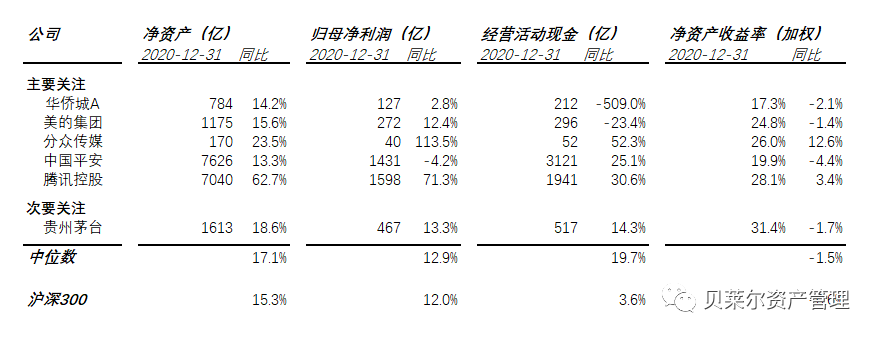
We buy stocks not in the expectation of rapid appreciation in the near future, but as long-term partnership interests of the company. Rather than focusing on short-term stock price changes, we prefer to examine the changes in the company's business results and its intrinsic value under different economic conditions each year. The following table lists the companies we focused on last year (please refer to the 2019 investment memorandum) and some of their key operating data over the past year. Since the understanding and calculation of intrinsic value include too many subjective factors, the net assets, net profit, operating cash flow and return on net assets of the company's annual report are used here as the medium to measure the company's value.
Figure 1. Operating data of companies we focus on and companies in the Shanghai and Shenzhen 300 Index
Data source: Annual report of listed companies
Note: This list does not represent a company's position or recommendation
It can be seen from Figure 1 that some companies with a high proportion of offline companies have been directly affected by the epidemic and have weakened slightly, such as Ping An of China, which relies on face-to-face sales by agents, and OCT A, which relies on theme park games, commercial and real estate sales. These unfavorable factors are offset by companies that have a high proportion of online companies or have indirectly benefited from online channels, such as Tencent Holdings, which has experienced explosive growth in game and video business due to home isolation, Midea Group, which has benefited from production capacity transfers due to the closure of overseas factories, Focus Media, whose business is picking up due to the increased willingness of customers to advertise in the new economy. In the past year, the median growth in net assets, net profit attributable to parent shareholders and cash flow from operating activities of these companies reached 17.1%, 12.9% and 19.7% respectively, and the weighted return on equity fell by 1.5%. During the same period, the median growth in net assets, net profit attributable to shareholders of the parent company and cash flow from operating activities of the Shanghai and Shenzhen 300 Index was 15.3%, 12% and 3.6% respectively, and the weighted return on net assets fell by 0.6%.
Careful readers will find that these six companies are the six companies listed in our investment memorandum last year, but one of them, Kweichow Moutai, is placed in a secondary position. Before entering the topic of Kweichow Moutai, we need to emphasize that the six companies we are focusing on all have huge potential. They all provide rare, highly competitive, and even desired products or services on the market. As China's economy continues to grow, people's continuous yearning for a better life, and disposable income gradually increases, the value of these companies has great potential to continue to increase in the next few years. But this does not mean that buying these companies will make a profit at any time. Great investment opportunities are never rare. Review the three dimensions of our focus mentioned in the first memo:
A better margin of safety;
Long-term competitive advantage;
Management with both moral integrity and political integrity (especially cost control and capital allocation capabilities).
In a short period of time (such as one year), there are very few companies that can meet all three dimensions at the same time. Most of the time, the few companies in the market that can satisfy the second and third dimensions often make people shy away from them in the first dimension.
In the vast majority of cases, we tend to hold companies we like, even if the prices of some companies increase significantly due to Mr. Market's sentiments or preferences. Compared with the turnover rate of hundreds of most funds with value investment names on the market, Bel Air's turnover rate is only 30%. But when market prices have fully or even over-evaluated the profit prospects for the next few years under excellent circumstances, we become very cautious. We feel that there is nothing wrong with being afraid when others are greedy.
Think about it carefully, the above paragraph is actually quite contradictory. It was said that for a good company, no matter how high the price was, we would still hold it. Later, we said that if the price was too high, we would still sell it, as if we were schizophrenic. Just like the line the police said to Deng Chao in the movie "Mermaid" when laughing,"We have been strictly trained to not laugh no matter how funny it is. Unless I can't help it." In fact, this schizophrenic mental torture has tortured every investor who pays attention to Kweichow Moutai (or other high-quality group stocks) in the past year. Let's talk about how we view this issue.
2. Guizhou Moutai
Kweichow Moutai is a great company with a very wide moat and unique products. As for how good this company is and how wide the moat is, the market has been telling endlessly for nearly 10 years like the surging Chishui River. There is not much meaning for us to repeat here. In this field, whether listed companies, distributors, shareholders, researchers, or investors, everyone has made a lot of money in the past ten years. So, we want to ask two questions now. First, what about consumers? What do they think? (The consumers mentioned here do not include collectors, but only refer to those who have actually opened the bottle and consumed it.) In this feast of rising volume and price, are they also celebrating the success of Moutai? Second, is this growth of Moutai sustainable in the long term? Can Moutai replicate this success in the next decade?
Regarding the first point, we interviewed consumers in all circles (finance, real estate, infrastructure, etc.), and we found that even elders with considerable purchasing power complained that the price of Moutai was too high (especially compared with the previous two years), and even bluntly said that they couldn't afford it. Some blame scalpers for frying, some blame dealers for hoarding goods, and some say that winery management is not in place. But for now, despite all the talk, I still buy it. After all, without it, important banquets (such as weddings) may be afraid that the quality is not enough and the guests are neglected, and business banquets may be afraid that things may not be negotiated well and affect business. In any case, many consumers still have to pay for Moutai's current high prices, but at the same time, such high prices are slowly consuming the brand capital accumulated over the years. Who knows if this increase will hit the red line of 30% premium for Duracell batteries and consumers will not pay at all? I'm afraid no one can explain this question clearly. However, the current market seems to believe that this red line does not exist for Moutai.
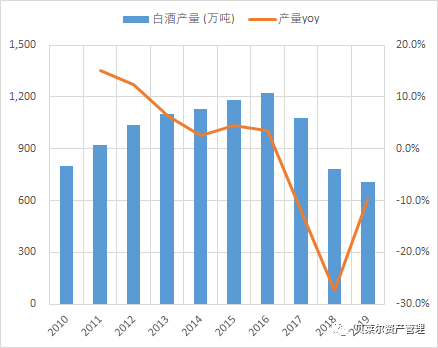
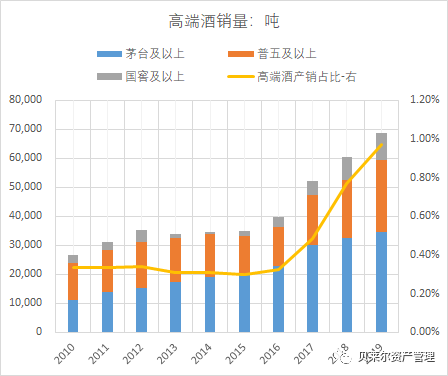
Regarding the second point, is this growth of Moutai sustainable in the long term? Let's first take a look at the growth of sales of liquor and high-end liquor in my country over the past ten years:
Figure 2. China's liquor production (top picture), high-end liquor sales (bottom picture), 2010-2019
Data sources: National Bureau of Statistics, annual reports of listed companies, and securities firms
We observed:
In the past 10 years, the output of the liquor industry has dropped significantly after peaking in 16 years. It may be that as young people born in the 1980s and 1990s enter society, the phenomenon of "young people do not like to drink liquor" has emerged, so overall consumption has a situation of "peaking and declining";
In contrast, sales of high-end liquor represented by Mao Wulu have bucked the trend and increased. Sales have increased from 26,700 tons to 68,600 tons in the past 10 years, corresponding to a compound growth rate of approximately 11%, and a compound growth rate of approximately 15% in the past five years;
In addition to the surge in sales, production capacity must naturally not fall behind. According to former Moutai Chairman Li Baofang publicly stated at the 2019 Boao Forum for Asia Consumption Sub-Forum, Moutai's production capacity is 56,000 tons and is expected to be completed by the end of 2020. According to the "Detailed Construction Plan of Kweichow Moutai Liquor Co., Ltd.(Detailed Construction Plan of China Area)", Kweichow Moutai has a long-term goal of adding 19,000 tons of Moutai liquor production capacity during the 14th period from 2021 to 2025. If the Zhonghua area is completed on time in 2025, the Moutai liquor production capacity will reach 75,000 tons (based on 56,000 tons at the end of 20 + 19,000 tons added during the 14th period = 75,000 tons). Wuliangye and Luzhou Laojiao, both high-end liquors, are not willing to be outdone. Wuliangye currently has a high-end product production capacity of 32,000 tons. It is expected to form a pure grain solid production capacity of about 400,000 tons by 2025. High-end products ("Pu-V" and above) may achieve a production capacity of 40,000 tons (roughly based on 10% high-quality wine production rate). Luzhou Laojiao recently stated that it expects the production capacity of high-end liquor national cellar to reach 15,000 tons in 20 years, and a production capacity of 2025 to 25,000 tons will be formed. In other words, the production capacity of high-end liquor has increased from about 40,000 tons in 2015 to 103,000 tons in 2020 (56,000 tons of Maotai +32,000 tons of Wuliangye +15,000 tons of Luzhou Laojiao), and will continue to increase to 140,000 tons in 2025 (75,000 tons of Maotai +40,000 tons of Wuliangye +25,000 tons of Luzhou Laojiao).
These aggressive capacity expansions describe a deja vu optimism, with huge profits and growth causing the industry to relax its vigilance. When a company starts increasing capital expenditures, competitors will catch up because they don't want to lose market share. What management likes to do most is to copy other competitors because there is the least resistance and if you fail, you will not be alone. During the market boom, players in all industries expanded production capacity with great fanfare, and all funds flowed in one direction. In an industry that has historically been cyclical, management, analysts and investors have identified a linear future of unlimited growth.
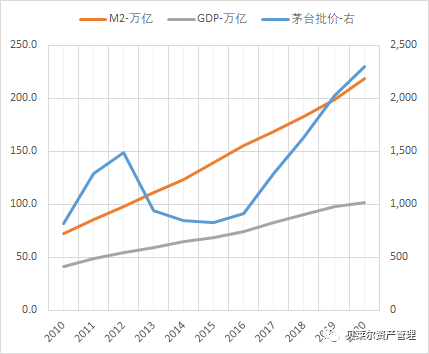
If Moutai is simply used as a consumer product, then its volume and price growth has certain limitations. At this time, friends who support Moutai may emphasize that Moutai is not only a consumer product, but also a scarce asset that can absorb inflation. This view is not groundless. First, the longer Moutai is kept, the more fragrant it is and the higher its value (Dutch tulips do not have this attribute). Second, even if the supply of Moutai increases, it is still quite limited (the supply elasticity of real estate in the United States is extremely high: in 2006, the stock of new homes in the U.S. real estate market increased to five times the number of new households that year). If we compare Moutai with the changes in broad money supply (M2) over the past ten years.
Figure 3. M2, Moutai Batch Prices and GDP, 2010-2020
Data source: National Bureau of Statistics, brokerage caliber
We will find that the overall growth rates of the two over the past decade are surprisingly close, both far higher than the growth rate of GDP. As an extremely scarce and highly desired product, Kweichow Moutai's product prices have outperformed the M2 banknote printing machine in the past ten years. This illusion will lead people to overlook two main points: First, perhaps due to cyclical reasons, Moutai has not outperformed M2 for six years in the past ten years. Second, M2 may not grow as rapidly in the next decade as in the past.
It must be clarified that we do not believe that Moutai's business will decline for a long time (even if it is cyclical). We only believe that current market prices (as high as 50 or even 70 times spot profits) have fully or even over-reflected the profitability of the next few years under excellent conditions. In the investment field, premature correctness may also be a mistake. Let's look at Coca-Cola and Wal-Mart, which were valued at 50 times in 1998. In the ten years since then, they have both achieved extraordinary double-digit annualized growth, and they have always represented the best brands in their respective fields, whether in 2008 or 20 years later in 2018. But being their investors may not be so comfortable. In the ten years from 1998 to 2008, the stock prices of Coca-Cola and Wal-Mart did not rise at all, but the valuation dropped from 50 times to 15-20 times (to do a simple arithmetic, assuming an annualized growth rate of 13%, net profit will increase by 2.4 times in 10 years. Even if the stock price remains completely unchanged, the valuation of 50-70 times will only return to 14.7-20.6 times). Therefore, it is no wonder that Buffett reflected in his annual investor letter on why he didn't sell Coca-Cola at a time when the valuation was high."I also found it very strange what I was thinking at the time."
(Risk warning: Kweichow Moutai's growth in the next ten years will far exceed expectations. Although there are still many people willing to take this risk nowadays).
3. Overseas Chinese Town
Compared with the overcrowding in the liquor industry, there is one industry that has been the most unpopular in the past two years, and that is real estate. Last year, because the stock price was too impassioned, it was once dubbed by many media as the three fools of A-shares (the other two fools were banks and insurance). If you have attended the annual meeting of securities firms, you will have observed an interesting phenomenon. The liquor branch venue is often crowded with people. Even those standing and listening are on the three floors inside and outside. If you go late, you can't even enter the door. On the contrary, half or even two-thirds of the seats in the branch venue of the real estate company may be empty. If there was a "resource allocation officer" responsible for managing the order of the venue, he would definitely move some people from the crowded liquor venue to the empty real estate venue. By the way, isn't the essential meaning of finance based on society resource allocation?
We will be interested in industries where banks are withdrawing funds (willingly or reluctantly), investors are leaving, markets are ignoring while competition is weakening, concentration is increasing, consumers are still enthusiastic and have quite attractive valuations. It is not easy to find a target that meets these seven conditions in the real world. I guess it should be similar to the difficulty of gathering seven dragon balls to summon the dragon dragon in the animation world. Of course, not all companies in this rare industry have investment value (since supply is being cleared, you don't want to hold on to the target of being cleared). We just believe that the purpose of policies such as no speculation in housing, three red lines, and two concentrations that make the market pale is not to make this industry disappear, but to enable the industry to develop healthily in the long term. Then companies in the industry with unique competitiveness, differentiated positioning and low-cost operations will continue to create value.
We believe OCT has the potential to become such a company. From a manufacturing perspective, OCT has the lowest raw material costs in the industry (Land acquisition is often at or near the reserve price: According to the annual report, 28 of the 47 land projects the company acquired in 2019 were delisted at or near the reserve price; In 2020, 23 of the 25 land projects acquired by the company were delisted at or near the reserve price), with the lowest cost of production materials (its average financing interest rate is lower than that of industry leader Vanke), and its products can often be sold at the highest price in the market (the selling price is a bit higher than that of surrounding buildings, and the gross profit margin is extremely high).
When we first came into contact with this company a few years ago, we judged it to be an investment opportunity that might be a bit biased towards Graham-style cigarette butts stocks. The company's management is not aggressive enough, and the real estate development turnover is slow, but the asset quality is excellent. Many of them are extremely scarce areas in first-tier and second-tier cities. At that time, the market price was at a large discount to the asset value (even under the stress test situation of a sharp drop in house prices). After continuous follow-up, observation and in-depth experience of its products, we learned that the company's business model and management have undergone exciting changes.
First of all, let's talk about the business model. Friends who have been to Happy Valleys in various places know that OCT represents tourism real estate. In fact, over the past ten years, OCT's business model has been continuously explored and evolved under the leadership of management. From tourist attractions such as Window of the World and Folk Culture Village that you can only visit once or twice in your life, to playgrounds such as Happy Valley and Maya Beach that you can visit once or twice a year, to commercial and entertainment complexes such as Happy Coast and Happy Harbor that you can visit several times a month (I found that I have been going to Happy Coast every week recently, where my baby signed up for swimming lessons, and he also likes to eat noodles and cheese cakes from the newly opened Xibei Restaurant). Let's take a brief look at two cases of this latest business model:
Shenzhen happy Coast
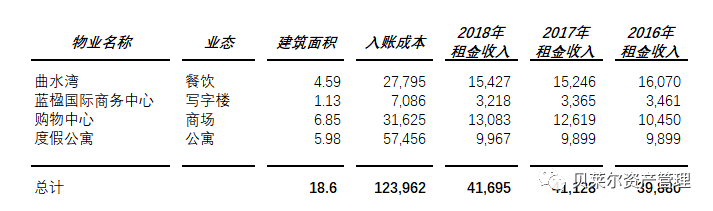
The earliest phase of Shenzhen Happy Coast opened in 2012. Geographically, it is located at the core of the Shenzhen Bay Business District and belongs to the golden area at the junction of Nanshan District and Futian District. It is a cultural and tourism complex that integrates multiple business formats such as Happy Coast Shopping Center, International Business Center, Holiday Apartments, and Qushuiwan Special Dining Area.
Figure 4. Investment real estate situation in Shenzhen Happy Coast (Unit: 10,000 square meters, 10,000 yuan)
Data source: 2018 and 2019 Joint Credit Rating Bond Tracking Rating Reports
According to the bond rating report of the Joint Credit Ratings, the four major sectors of Shenzhen Happy Coast (Qushui Bay Catering, Lanyan International Business Center, Happy Coast Shopping Center and Holiday Apartments) contributed rental income of 399 million, 411 million and 417 million respectively in 2016-2018, while the recorded cost was only 1.24 billion.
Shunde Happy Coast PLUS
The project was acquired in October 2013 (the government handed over the land in early 2014). Pre-sale of the first phase of the commercial housing Swan Lake project in early 2015. At the end of 2015, the Happy Coast project acquired land (residences, apartments, commercial facilities, shopping centers, etc.). In September 2019, Happy Coast PLUS opened.
Direct investment in real estate (including Swan Lake, Lanying Bay, etc.) and cultural tourism (including theme parks, shopping centers, etc.) is over 10 billion yuan. In 2018, the overall project cash flow will be positive, including real estate and cultural tourism (equivalent to 4 - 5 years for the overall capital flow to be positive). In 2019, the total profit was nearly 3 billion yuan, and billions of cultural and tourism assets worth nearly 10 billion yuan of saleable value were still held on the books (Swan Castle, Lanyanwan, etc.).
Shunde Happy Coast has gained extremely high popularity in the local area and even the entire Guangdong Province. Within one year of opening, the project received 8.8 million tourists (Shunde's permanent population in 2020 was 2.8 million, and the permanent population of the entire Foshan City in 2020 was only 8.15 million), creating jobs for 3500 people. Its iconic Ferris wheel "Shunde Eye" has also become the preferred check-in point for local young people.
In addition to the evolution of business models, we see that the company's management is also constantly groping and evolving. During a survey a few years ago, we asked their executives a more acute question. We believed that at that time, the company offered salaries far below the industry average, making it difficult to attract and retain talents. The senior management team was very sincere, explained the limitations of being a state-owned enterprise, and also said that they would actively communicate and strive for it. In the past few years, we have indeed seen a significant increase in the overall salary level of OCT, and the company has also introduced a system of binding interests such as equity incentives and project investment. In addition, OCT's cash flow and dividend rate have improved significantly. We are very pleased to see this positive change in OCT and its management. We learned that OCT is currently copying and pasting the promising Happy Coast model across the country. We will continue to pay attention to the cash flow, liabilities and other operating conditions of OCT, and we are also looking forward to the future development of OCT.
(Risk warning: OCT management changes, house price collapse).
4. Safe China
As mentioned earlier, a new term emerged in the financial circle last year-the A-share three fools, namely banking, insurance and real estate. If you want to choose the most "stupid" among so many three "stupid" in the stock market, then Ping An China will have the honor. Ping An Group of China not only integrates banking and insurance, but also invests a large amount of real estate-related assets (such as Huaxia Happiness). According to San Sha, this should be considered to be a third power of stupidity.
Unfortunately, when we look at a company, we don't include evaluating and explaining its popularity with Mr. Market, nor does it include predicting stock market or macro fluctuations. What we value is whether it has distinctive value. Here we will only discuss the two topics of Ping An's reform and investment in China to see how "stupid" or valuable he is.
reform
In 2018, Ma Mingzhe said: "Ping An has been planning for two to three years to study reform strategies and find a path for life insurance development that converts old and new momentum. Now it seizes the opportunity to adjust and lay a solid foundation for continued growth in the future., Be prepared to ensure the formation of a high-quality sustainable development platform" kicked off the reform of the manager team. Now, more than two years have passed, and 30% of the agent team has been eliminated.(From 1.41 million in the 2018 annual report to 985,000 in the first quarter of 2021), the per capita value of new business fell by 17%(From 48789 yuan in the 2018 annual report to 40688 yuan in the 2020 annual report), the value of new business dropped by 2.2%(from 57.1% in the 2018 annual report to 54.9% in the 2020 annual report), and the average income of agents also decreased by 8%(from 6294 yuan in the 2018 annual report to 5793 yuan in the 2020 annual report). It seems that from any angle, the results of the reform have not appeared as expected (at least not yet). Negative results such as loss of insurance policies, departure of executives, and reduction of personnel do indeed occur. There are already many voices in the market calling on Ping An to reflect on whether it has given up the crowd tactics too quickly. At this moment, should we continue to adhere to this reform that has lost our wives and lost our troops?
We believe that this reform is essentially another test of scale and quality. Historically, Ping An's management has faced severe challenges between scale and quality many times. From the withdrawal of property insurance from the ship insurance market to the proactive adjustment of the product structure of bank insurance and group insurance, every decision reflects the management's long-term thinking and its grasp of the lifeblood of the financial industry. We firmly believe that the financial industry is not about who runs faster, but about who lives longer (taken from Tencent's Xiaoma Brother). In "Ping An Xinyu", Chairman Ma Mingzhe has the following statement:
"Many companies and entrepreneurs have the urge to grow bigger. Being big in itself is not a bad thing, but being big that ignores benefits is difficult to last. Being big with huge resource consumption is at the expense of shareholders 'interests and corporate value. At the cost, the gain is not worth the gain. Ping An wants to become a century-old store in the financial industry. There is still a long way to go in the future. The dialectical unity between strong and big cannot be unclear. Only by being truly strong and truly big can we achieve the goal of a century-old store."
The same challenge has occurred in AIA in Hong Kong, Cathay Pacific Life in Taiwan and insurance markets in various places. By observing their transformation, we can better understand the forward-looking nature of Ping An's strategy and the possibility of transforming high-value routes.
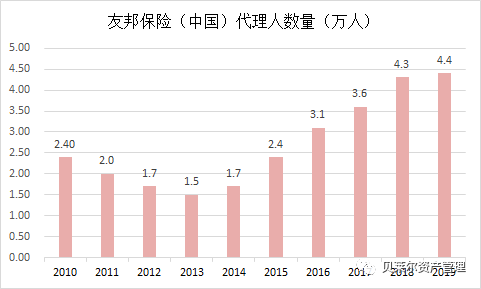
Before 2009, AIA adopted the human-to-people tactics we now know, focusing on expanding its scale and improving brand awareness in the market. It is characterized by rapid occupation of market share through rapid expansion of the agent team. Since 2010, aware of the risks contained in the industry's scale trap, AIA has begun a strategic transformation, focusing on cultivating professional elites and reforming systems, products, channels and other aspects:
The system is oriented to high value, and the assessment system for senior executives is divided into two types: short and short periods. The long-term assessment is mainly based on shareholder value return (including operating profit, dividends, and stock price), and the short-term assessment is based on the value of new business-60%, After-tax profit-25%, free earnings-15%(additional embedded value growth 19 years ago);
Start to "elite" the channel, terminate inactive agents, strengthen the recruitment and training of the agent team, and launch the "best agent" strategy-using the promotion of the "Million Roundtable" as a measurement indicator;
The products emphasize high value, focusing on protection-type products (traditional life insurance dividend insurance), with long design periods and high premiums.
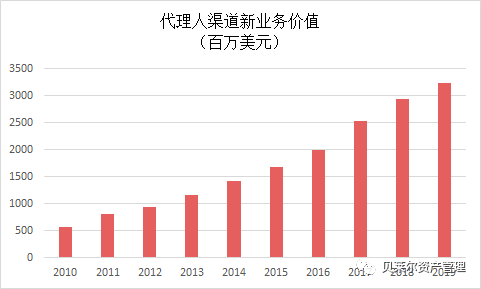
During the reform period, AIA also experienced a three-year labor loss (2010-2013), and it was not until 2015 that the number of its agents returned to its original position. However, through the above reforms, the efficiency of AIA's agent team and per capita production capacity have been greatly improved, and AIA China's new business value and per capita income have experienced sustained and significant growth.
Figure 5. Number of AIA Agents (Top Picture) and Value of New Business (Bottom Picture) 2010-2019
Data source: Annual report of listed companies
Compared with AIA's proactive transformation to the end, Taiwan's Cathay Life Insurance's transformation process appears to be slightly repetitive. Let's sort out the beginning and end of Cathay's strategic transformation based on the timeline:
As early as 2006, Cathay Life Insurance proposed to develop more protection products. However, the actual situation is that for a long time, it still focuses on selling short-term annuities and investment-based insurance that meets the hot demand of the market;
From 2009 to 2012, in the context of the global financial crisis and quantitative easing, interest rates fell sharply. Taiwan's regulators began to guide the industry to sell long-term products and ban the sale of short-term annuity products. Cathay Pacific began to emphasize concepts such as after-tax earnings, risk management and control, and customer stickiness to weaken its market share target. Specific measures include improving the quality of its agent team, improving service quality, promoting personalized sales, and reducing costs and increasing efficiency in technology investment;
From 2013 to 2017, Cathay Pacific began to emphasize the balance of value, risk, scale and value, continued to weaken market share thinking, and began to disclose the value of new businesses. Specifically, the product side continues to promote the sales of long-term payment products and group cross-product products; the channel side still focuses on improving the quality of the agent team and launches some activities to increase customer stickiness, including electronic efficiency improvement, health activity experience, VIP services, etc., the overall implementation effect is reflected in the increase in net interest rates, the increase in the proportion of highly educated agents, and the increase in the value rate of new business, but there are still some setbacks during the period;
2018 - 2019: Cathay Pacific began to emphasize shareholder returns, returned to the "essence of insurance", and launched more health care insurance types, showing a certain shift in sacrificing market share and pursuing quality.
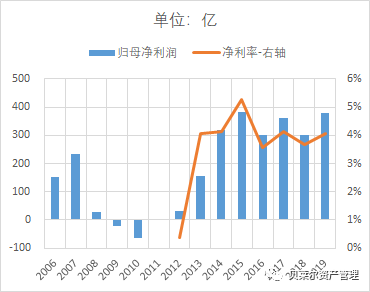
Figure 6. Cathay Pacific Life Profit Data 2006-2019
Data source: Annual report of listed companies
It can be seen that it is also a transformation. Cathay Pacific's ideals are full, but the reality is very bony. Many management strategies and ideas have not been implemented quickly due to subjective and objective reasons such as execution and the financial crisis. Affected by market changes in the early stage, the team was chasing short-term market hotspots such as short-term annuity insurance and overseas asset-related insurance. In the medium term, due to low enthusiasm for actively seeking change, it was actually a little pushed forward by supervision. After repeated groping, Cathay Pacific's overall performance has improved significantly compared with the beginning of the period. On the one hand, it benefited from the global economic recovery and the upward interest rate environment 12 years later, and on the other hand, it benefited from the company's "value-oriented" choices. It can be seen that the company's profit margin and new business value ratio have begun to pick up, the cost of debt has continued to improve, and the quality of channel personnel and per capita production capacity have also improved.
For Ping An of China, the reform/transformation experiences of AIA and Cathay Pacific are quite instructive. According to Ping An's 2020 annual report, Ping An's life insurance reform has deeply implemented the "channel + product" two-wheel drive strategy, and will comprehensively promote the reform from the four major directions of channel, product, management, and culture, integrating the financial product system and leading scientific and technological strength. Implementation of the project. We believe that Ping An is closer to AIA in terms of positioning, strategic deployment and execution, and closer to Cathay Pacific in terms of market position, scale and breadth of service population. Whether it is AIA or Cathay Pacific, it is difficult for the reform to be smooth sailing through combining the advantages of comprehensive finance and technology to embark on a unique path for Ping An. However, at least we know that the three necessary conditions for enterprise reform and transformation are all in place:
1. The core business has not yet declined significantly, and it can continue to provide cash flow and resources for transformation and transformation;
2. The management with foresight and courage dares to give up the current pursuit of short-term scale and its own bonus dividends;
3. An executive culture and a united team recognize the direction of the company and carry out the reform to the end.
Therefore, I think we must give peace a certain amount of patience and a certain amount of time.
investment
In the past year, Ping An has been full of controversy over investment. The first thing to bear the brunt is the happiness of China, and major media also once pushed Ping An to the forefront. Let's first take a look at the beginning and end of Ping An's investment in China's happiness incident:
In July 2018, Huaxia Holdings transferred 582 million shares of the company to Ping An Asset Management through an agreed transfer method, accounting for 19.70% of the company's total share capital. After the transaction was completed, Ping An Asset Management's stake in Huaxia Happiness increased to 587 million shares, and its shareholding ratio increased to 19.88%, becoming the second largest shareholder of Huaxia Happiness;
In February 2019, Wu Xiangdong, former executive director of China Resources Land, led a team of 100 people to parachuted into Huaxia Happiness and became co-chairman and CEO. Since then, Huaxia Happiness began the situation of Wu Xiangdong and Wang Wenxue "dividing the north and south";
On the evening of February 1, 2021, Huaxia Happiness issued an announcement to disclose its recent debt problems for the first time. The announcement stated that the amount of principal and interest involved in overdue debts was 5.255 billion yuan, but the company's available funds were only 800 million yuan;
Wang Wenxue, chairman of Huaxia Happiness, recently criticized himself in his speech, saying that he was ambitious and impatient. At several key nodes, I "gambled wrong". First, in 2016, we misjudged the situation and increased investment in Beijing. Soon, regulation of the property market around Beijing came, and both volume and price fell. Then in 2017, we expanded into new regions and invested in external regions such as the Yangtze River Delta, Guangdong, Hong Kong and Macao. As a result, the money fell into the cycle again. Finally, several rounds of epidemics in 2020 completely detonated these crises;
On February 4, 2021, Ping An of China held a 2020 annual results conference. Xie Yonglin, managing director and co-CEO of Ping An Group, pointed out at the meeting that Ping An's investment in Huaxia Happiness totaled 54 billion yuan, including equity investment of 18 billion yuan and on-balance sheet bond investment of 36 billion yuan, and will make provisions in a timely manner according to the process;
In April 2021, Ping An of China announced that in the first quarter of 2021, the company's impairment provision and valuation adjustment on Huaxia Happiness related investment assets amounted to 18.2 billion yuan, which would affect the net profit attributable to shareholders of the parent company after tax. The amount of impact on operating profit attributable to shareholders of the parent company after tax is 10 billion yuan, and the amount of impact on operating profit attributable to shareholders of the parent company after tax is 2.9 billion yuan.
This can easily remind investors of the failure of Ping An China's investment in Fortis Bank in 2007 (a loss of tens of billions). Wasn't the lesson from stepping on thunder at that time not profound enough? Back at the 2008 annual report conference, we saw Chairman Ma Mingzhe making the following statement when summarizing the investment failure:
"We focused on studying various risks in Fortis's industries, regions, countries and neighboring countries. During the argumentation, we felt that we were still cautious and rational, but we only considered the countries and regions where Fortis is located, and this financial turmoil is global and systematic. The 'Hobilou' area, which used to be considered to have less fluctuations, has also been affected."
Ping An's team has established a prudent and rational investment system and also paid attention to possible macro risks, but may have ignored the more important micro level-management. You should know that an overly radical management culture can easily destroy a company, even if it is a century-old foundation. Just look at Lehman Brothers and AIG in the subprime mortgage crisis. And a management that pursues prudence and prudently style can allow even companies at the center of the storm to weather the difficulties safely, such as Berkshire in the United States, Wells Fargo Bank in Europe, and Sanp Financial Group in Finland.
Let's go back to the Huaxia Happiness incident. At the Ping An Annual Report press conference, Xie Yonglin pointed out that Huaxia Happiness is in trouble for three reasons: first, the regulation of the Beijing-Tianjin-Hebei region has become stricter in recent years, which has a huge impact on its return; second, the COVID-19 epidemic; Third, the company's own management is extensive and expansion is too fast. Different from the previous Fortis, Ping An saw the radicalization of the company's management from this reflection. Even if we saw the problem, we still couldn't help but ask, why didn't we see this risk when investing in Huaxia Happiness? It should be evident from the management's long-term high debt, long payment cycles, and high-pitched style (of course, this is a bit wise after the fact). So what attraction or magic was there about this investment that caused the most critical management risk to fall into the blind spot?
Xie Yonglin, managing director and co-CEO of Ping An Group, said at the press conference,"At that time, I invested in Huaxia Happiness because of its business model as an industrial new city operating company, that is, primary and secondary joint development, introduction of industries, and support for the development of local governments. This business model is in line with the investment nature of insurance funds."
The development of Huaxia Happiness in recent years is indeed as Xie said. After investing in Huaxia Happiness, Ping An brought in Wu Xiangdong from China Resources Land, a veteran of successful projects such as Shenzhen Vientiane City and China Resources City, to establish the Southern Base Camp. Wu Xiangdong also brought a team of hundreds of people from his old club China Resources to prepare to deeply explore first-tier and second-tier cities and commercial real estate. In just over a year, the team led by Wu Xiangdong handed over a good answer. According to the Huaxia Happiness Annual Report, Huaxia Happiness's new business in 2019 has covered 4 cities, landing two projects in Beijing Lize and Wuhan Yangtze River Center., serving 8 urban renewal projects, adding 1.71 million square meters of new land reserves, focusing on layout in 5 metropolitan areas and 8 core cities. In the first half of 2020, many promising commercial projects such as Nanjing Daxaochang, Wuhan Zhongbei Road, and Guangzhou Baietan Industrial Financial Service Innovation Zone were obtained. The projects of these southern companies basically serve Ping An. Judging from the achievements of Huaxia Happiness South in such a short period of time, Ping An and Huaxia Happiness have indeed produced some positive chemical reactions. However, with the debt crisis emerging from the aggressive expansion of Huaxia Happiness's headquarters North, Huaxia Happiness South Company's high-quality commercial projects may fall short.
Obviously, Ping An values the synergy between entering commercial and pension real estate before strategically investing in China Happiness. Pursuing synergy is a common operation of Ping An in investment, which can be seen in cases such as Car Home and Ping An Good Doctor. By helping attract customers, cross-selling, and increasing the added value of services, Ping An not only allows the bidders to gain additional business and growth, but also successfully feeds back the fundamentals of its own insurance (generally speaking, strategic investments that pursue synergy have a high failure rate, and if you seek to control or intervene strongly in management, the problems will be easier). There is nothing wrong with investing in real estate. High-quality commercial real estate projects usually have the characteristics of long cycles and stable returns, which are highly matched with the special requirements of long duration and continuous expenditures of insurance companies on the debt side (i.e. various policies). If we follow the development history of many overseas insurance companies, Ping An's current proportion of funds invested in real estate may be low. But unfortunately, this investment in Huaxia Happiness had just begun to take shape and improve when the entire project collapsed. Ping An overemphasized strategic synergy and forgot the source of investment. In Buffett's words, these are three simple sentences:
Don't lose your principal.
Don't lose your principal.
Don't lose your principal.
Whether it is necessary to have a moat, a management with both moral integrity and political integrity, the purchase price is cheap or reasonable, or an understandable business. These requirements are actually for the above principle, not to lose principal. But this is easy to say. Everyone over-focuses on a certain point of the underlying asset and leaves the key factor that determines the loss of principal in a blind spot. For example, Buffett himself, who said this, has been deceived for many years because he paid too much attention to the margin of safety and bought the declining textile giant Berkshire at a low price.(At that time, the labor-intensive textile industry had begun to move to Asia, but later it finally recovered through the insurance business.) It also almost destroyed the subprime mortgage crisis because it was excessively addicted to floating deposits and bought General Reinsurance through a stock exchange.(Later, it was discovered that there were many problems with underwriting, reserves, and derivatives. It took many years to clean up the mess. Fortunately, the derivatives business was cleaned up before 2007, but it was still due to this investment. The huge amount of floating money brought about by too large a scale led to a decline in the yield).
It can be seen that both ordinary people and investment masters will make mistakes. The most important thing is how to face these mistakes, how to learn from them and grow. Yao Bo, co-CEO of Ping An Group, pointed out that after the China debt crisis, Ping An has conducted several rounds of in-depth reflection, including whether it can do better in pre-investment due diligence, and whether it needs to conduct more rigorous management and track after investment. Corporate performance and timely identification of problems.
We should not dwell on the mistakes we have made and deny the whole thing in a partial way. If it is necessary to assess Ping An's past performance, why should we stick to Huaxia Happiness (equity plus bond investment exposure of 54 billion yuan/China Ping An insurance investment scale of 3.7 trillion yuan), which accounts for less than 1.5%, while ignoring Ping An Bank, which accounts for 20% of revenue from zero to present (embedded value accounts for 12%)? In fact, Ping An's investment capabilities cannot be fully reflected even by the two figures disclosed in his annual report: net investment return rate and total investment return rate, which have been among the top three in the industry for many years. That's just a measure of its investment level as an insurance company. You must know that Ping An was only a property insurance company when it was founded. Twenty years ago, it integrated property insurance and life insurance into one. Ten years ago, it evolved into a comprehensive financial group covering insurance, banking, trust and other fields. Today, in addition to traditional financial business, he has also built and invested in a technology platform with 600 million Internet users, including leading technology companies such as Ping An Good Doctor, Lujin Institute, Financial Yizhitong, and Auto Home. It recently participated in the reorganization of Founder Group, including Peking University's medical industry system, at a bankruptcy price, and also highlighted the positioning of "medical care is the future" in its annual report. As for whether Ping An will successfully create a closed loop with positive effects in the medical field and insurance business in the future, and then evolve into China's version of UnitedHealth Group, or will become something else, to be honest, it is a bit premature to make a conclusion. We only know that over the past three decades, Ping An has been clear in its strategic deployment and has been fully implemented. There is reason to believe that Ping An's management and investment will be more prudent and sophisticated after repeated irrigation of success and failure.
(Risk warning: Ping An's management of China has undergone tremendous changes, reforms have failed, and investment has been continuously trampled on).
5. Tencent
When it comes to investment in pursuit of synergy effects, I have to mention Tencent. As the company most covered and researched by analysts inside and outside the industry, Tencent shines brightly during the epidemic last year due to the outbreak of the game business and the surge in the stock market. In the eyes of many people, it is one time China's version of social media giant Facebook, one time Nintendo with various game businesses, and one time a powerful Internet platform company like Microsoft. There is nothing wrong with this, but today I want to talk about its investment. We believe that management's capital allocation ability is a key factor affecting compound interest growth.
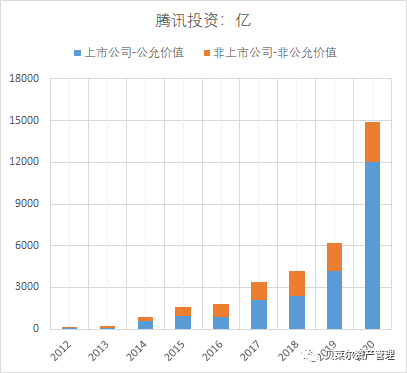
According to data disclosed in Tencent Holdings 'annual report, Tencent's holdings of listed companies increased from 5.5 billion yuan in 2012 to 1.2 trillion yuan (fair value) in 2020, while Tencent's equity in non-listed companies increased from 6.4 billion yuan in 2012 to nearly 300 billion yuan in 2020 (part fair value, part non-fair value).
Figure 7. Tencent Holdings Investment Asset Growth, 2012-2020
Data source: Annual report of listed companies
The growth rate of this investment asset makes Tencent the closest thing to Berkshire Hathaway (even ignoring the possibility of inflated stock market surges in the recent year). We thought about not including a specific growth rate percentage here, so as not to subconsciously or subconsciously lose control of linear extrapolation and cause excessive optimism. The current investment growth rate will naturally not be the norm. In addition, Tencent also has the following characteristics that make it different in terms of investment philosophy:
1. Although Tencent pursues synergy effects, it avoids majority shareholding or direct acquisitions, preferring to hold only a minority stake in the company and does not interfere too much in management. This investment philosophy is very far-sighted because:
No matter how large a company is, no matter how rich its resources are, it cannot always have the corresponding management knowledge or suitable management talents to run the invested company. As investors, we all hope to find opportunities for compound interest, but if every time we buy a company, we have to personally sit down or send our own personnel to enter or replace management, we will instead find that costs, management radius and required resources are at the compound interest level. Expand, and one day we will exceed the boundary or lose sight of one thing. Imagine if Buffett had to manage every company he bought or send personnel, how could he manage hundreds of companies with more than 20 people at the headquarters? It is more likely that he only owns less than 20 companies, because trying to intervene and manage the first ten companies is already exhausted and unable to separate himself. Then how can he talk about compound interest?
Investment models that pursue control often find only second-rate targets. Most first-class companies would not want to be taken over by investors with many strings attached and strong management intervention (think Vanke, Gree, and the Barbarians). If investors come hard, not only will the cost be too high, but it will also easily backfire. Then the option becomes to find second-rate and third-rate companies in the industry for strategic mergers and acquisitions. This choice is more likely to fail, and companies also have to pay high management and integration costs.
Business managers can easily lose their motivation to be owners after being acquired. They feel that the business they worked so hard to build is now just an extension of the acquirer's business. On the psychological level, the founder has actually transformed from a manager to a financial investor, and he is more likely to be inclined to get quick financial returns in management decisions. Therefore, we often see invested companies sign gambling agreements and promise performance growth (such as three years). As a result, once the gambling period expires, performance will soon fall off a cliff. In such a short assessment period, managers (who are actually psychologically financial investors) will inevitably do their best to overdraw corporate resources and sell long-term benefits to sprint short-term performance. In the end, they will happily receive huge bonuses, but leave a mess for the acquirer.
Tencent, which is well versed in these possible traps, usually only holds a minority stake when investing. Even if it holds shares, it avoids intervening in management, and more adopts a cooperative and empowering attitude to support the invested company. Let's take a look at Tencent's acquisition of Supercell, a Finnish-based game company that created the world-popular phenomenal game Clash Royale. After Supercell was acquired, their CEO published an article praising Tencent:
"First of all, we have reached an agreement with Tencent that Supercell will continue to operate independently-as it was when it was under SoftBank and will be in the future. Both Tencent and SoftBank can understand that it is the unique corporate culture and small but independent teams (we call them "cells") that create Supercell. We hope Supercell is and always will be the best stage for creative gamers. Also, our headquarters will remain in Helsinki and continue to pay taxes in Finland. All of this is important to us."
This investment method reflects Tencent's high degree of trust and tolerance as an acquirer. This culture of autonomy is reflected in many of Tencent's investments. It not only reduces management costs, but also creates more effective leadership. The company's management and members can be highly focused on their respective duties after the acquisition/shareholding, rather than focusing on the attitude of shareholders. For game companies such as Supercell and Riot Games, Tencent's shareholding not only brings huge market opportunities, but also provides a free soil to stimulate creative inspiration.
2. Whether for the target company or Tencent itself, Tencent can often elevate the value of its investment to another level. For the target company, Tencent's shareholding can not only provide huge traffic support, but also create cooperation opportunities with other companies in its ecosystem. Let's take a look at two details from the Supercell CEO's letter:
"China has the largest number of players in the world. Tencent's platform has 1 billion users (yes, 1 billion!), More than 300 million unique users play games on it. Cooperation with Tencent means to us that we can bring games to more players. Moreover, their social platform provides us with many new possibilities, especially in social gameplay. All of this is exciting!"
"Seriously, Tencent and Riot have created great success together. They are partners we have always admired and have given us a lot of inspiration over the years. Now we have an excuse to call Riot more frequently to chat!"
Just as Buffett's Berkshire purchase of a company might give a boost, many companies are now looking forward to Tencent's favor, which seems to mean they have received the highest certification in the Internet. For Tencent itself, in addition to obvious investment returns, it can also obtain many other benefits that cannot be seen in its financial statements. For example, Tencent can deepen its insight into new technologies and markets, and in some cases, it can also transform it into its own value assets by absorbing successful industry experiences. Investing in "League of Legends" developer Riot Games in 2008 (100% controlling in 2015) and contributing to today's most profitable mobile game "Glory of the King" is a good example. Tencent can sometimes recruit rare talents in this way to expand its team. Tencent invested in Foxmail in 2005 and absorbed its founder Zhang Xiaolong and his team into Tencent, resulting in WeChat, which later supported half of Tencent. The synergy brought by Tencent's unique investment philosophy can be seen.
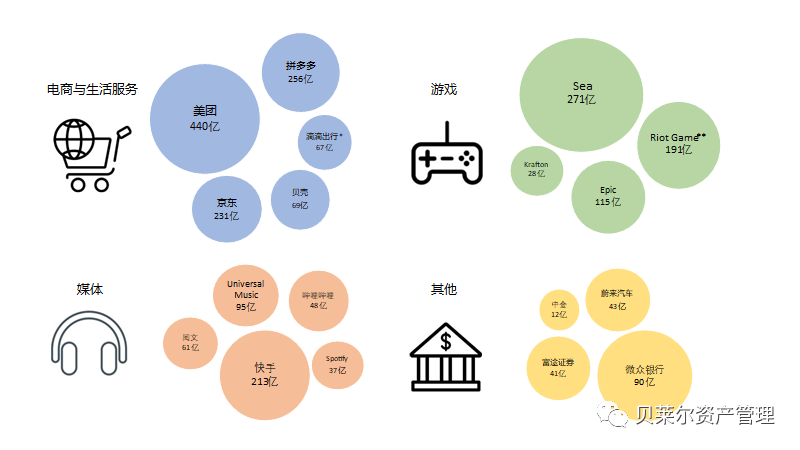
3. Tencent invests in the most promising companies in China and even the world. It can be seen that from Meituan, Jingdong, and Pianduo in the field of life services, to Riot Games and Epic Games in the field of games, to B-Station, Fast Hand, Reading in the field of multimedia, to Weizhong Bank, NIO Automobile and other fields, Tencent's investment has penetrated into all aspects of our daily lives.
Figure 8. Tencent Holdings Investment Map, 2020
Data sources: listed company annual report, Bloomberg data terminal
But on closer inspection, these companies and industries Tencent invests in are directly or indirectly related to Tencent's business, mainly in the consumer Internet category. When Li Zhaohui, Tencent Investment Management Partner and Vice President of Tencent Group, was asked in an interview with Business Weekly what he would not invest, he expressed this:
"A lot. For example, in the past few years, many A-share listed companies that have nothing to do with our business came to us to make fixed increases. As long as we were willing, the other party would give us a quota to participate in the additional issuance. There was a very certain profitability, but we did not do it. We clearly do not invest in new materials and communication equipment in the TMT field because we do not understand it. On the contrary, we see a company that has losses and immature management experience, but is very valuable and can meet the needs of a large number of users. Even if it faces many difficulties, we are willing to invest. Tencent works very hard in the areas we are good at and strategically framed. Such as games, social, video, cloud, etc. For other industries, such as traditional industries and the Internet, we will firmly support others in doing it."
We believe that it is very far-sighted to deeply cultivate within our own circle of capabilities, and it also reflects a kind of precious restraint, especially for Tencent, which has such a large capital volume and a solid market position.
(Risk warning: Tencent Holdings 'investment is required to be forcibly withdrawn).
6. Summary
In last year's investment memorandum, we judged that "due to the Sino-US trade conflict and the impact of the epidemic, the profits of most companies we focus on will almost certainly decline." What is surprising is that in such a challenging environment, we have been able to control the epidemic and achieve trade growth, and the companies we pay attention to have been able to turn the tide and achieve good results. An obvious conclusion is drawn here, that is, my macro prediction ability is really bad, but fortunately we only focus on the micro level.
This memorandum ends here. Thank you for taking your precious time to read such a nagging pile of words. If you have any questions, suggestions or criticisms about any content in the memo, please send an email to eugene_tu @ belaircapital.com.cn. Thank you very much.
(Special note: The above analysis is only used as an exchange of methods for studying industries and companies in the past year, and does not constitute a recommendation for buying or selling stocks of Kweichow Moutai, OCT A, Ping An of China, Tencent Holdings and other companies. For companies we have followed in the past year or years, we cannot confirm that we will continue to follow under any circumstances in the future.)
Belair Asset Management Co., Ltd. Tu Shiyang
2021/05/31
 Guangdong public network security no. 44000000000000


