This is the fifth investment memorandum for the fund managed by Bel Air Asset Management Co., Ltd. since its establishment in 2018. In this memorandum, I will introduce the operating profile of the company we have focused on over the past year, briefly talk about the current Shanghai Composite Index, our views on artificial intelligence, and discuss Kweichow Moutai, Tencent Holdings, Midea Group, Focus Media, and finance in different sections. Sector (Ping An of China, China Merchants Bank), real estate sector (Vanke Enterprise, China Resources Land, Longhu Group). I hope that through this communication, investors can better understand our investment style, recognize our long-term perspective, and at the same time realize our limitations.
I.Business Overview
Last year, the stock market experienced a major decline. The Shanghai and Shenzhen 300 Index of A-shares, the Windsor A Index and the Hang Seng Index of Hong Kong stocks fell by 21%, 19% and 15% respectively. When the entire market was panicked, especially in the second half of the year, we seized the opportunity to become greedy, and the number of targets we focused on increased from 5 to 9. The more the market collapses and the more sustained the decline, the more it will test the investment philosophy. We buy stocks not in the expectation of rapid appreciation in the near future, but as long-term partnership interests of the company. We are not interested in making quick money, and good investments usually take some time. I know very well that neither I nor the members of my team have the ability to obtain excess returns by predicting markets and stock prices. I also believe that our patience can allow us to go far.
Rather than focusing on short-term stock price changes, we prefer to examine the changes in the business results and intrinsic values of the companies we focus on each year under different economic conditions. The following table lists the companies we focused on last year (please refer to the 2021 investment memorandum) and some of their key operating data over the past year. Since the understanding and calculation of intrinsic value include too many subjective factors, the net assets of the company's annual report, net profit attributable to shareholders of the parent company, cash flow from operating activities and return on net assets are used here as the medium to measure the company's value.
Figure 1. Operating data of companies we focus on and companies in the Shanghai and Shenzhen 300 Index
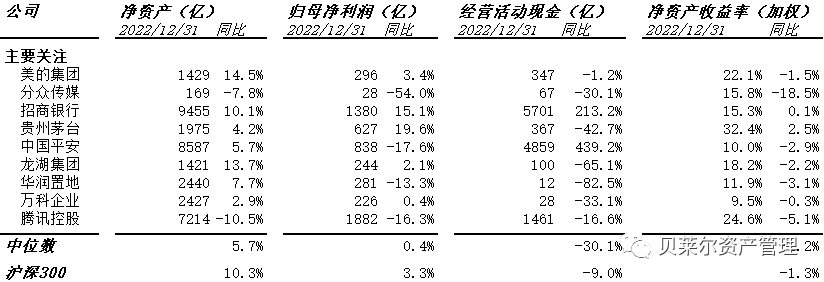
Data source: Annual report of listed companies Note: This list does not represent a recommendation or the company's current position. Even if it holds, the proportion may range from 0 to 40%
At the same time, we will also focus on other meaningful companies and assets, such as gold
It can be seen from Figure 1 that in the past year, many companies have faced considerable challenges at the operational level, while others have withstood macro pressure and continued to grow. In the past year, the median growth in net assets, net profit attributable to shareholders of the parent company, and cash flow from operating activities of these companies reached 5.7%, 0.4% and-30% respectively (mainly due to the addition of real estate companies), and the weighted return on equity decreased by 2.2 percentage points.
This has been a difficult year, but I'm afraid it won't be our most difficult year, especially since there are still some "positive alpha"(excess returns) from the perspective of stock price changes relative to the market. You know, in 1999, the Nasdaq index rose 80%, while Tiger Fund fell 18% and Berkshire fell 32% during the same period, because the market didn't understand why they were "stubbornly" investing in companies that generated real cash flow, rather than embracing hot stocks that were profitable in the future. This is the top fund manager in American financial history! I think we will definitely have bad moments in the future when we seriously underperform the major indices.
Speaking of indices, let's take a look at how the A-share index is performing and where it is now.
II.3000-point defense battle
Fifteen years have passed, but the Shanghai Composite Index is still at 3000 points! Whether it is the "3000-point defense war" or the "3000-point breakout war", this is actually a cliché issue. For a long time in the past, such battles would occur several times every once in a while, and all major media outlets reported to each other. In fact, the Shanghai Composite Index first reached 3000 points in February 2007. After tasting 6000 points and 5000 points in the middle, it returned to 3000 points last year. Even today, when the prospects of the stock's main "competitor" houses have become so bleak, investors seem reluctant to take a closer look at the stock market, preferring to put all their money in bank accounts for fixed periods (China Merchants Bank's retail fixed deposits last year increased by 53% year-on-year). After all, who in the eyes of this kind of thing that hasn't risen in 15 years will have investment value? Then are we, who self-proclaimed rational investors,"beauty is in the eye of the beholder"? Next, I would like to talk about our views from two aspects.
Figure 2. Shanghai Composite Index 2007.02-2023.04
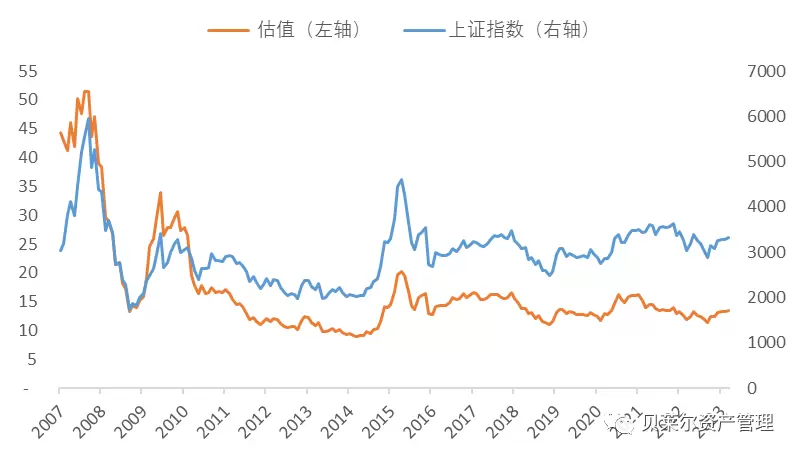
Data source: Wind database
First of all, the stock index has not risen for 15 years, not because there is a problem with the company and economy behind it. We used two methods to examine the changes in the financial data of Shanghai Composite Index companies. The compound annual growth rate of their net profit during this period (2007.12.31-2022.12.31) was 10.6 (using direct calculation method of wind data) or 9.3%(using reverse valuation method of price-to-earnings ratio), while their valuation (price-to-earnings ratio TTM) fell from 44 times to 12 times, equivalent to an annual decrease of 8.5% in valuations.
Secondly, referring to the stock markets of other economies, they have had several similar experiences. For example, the U.S. stock market has experienced two ultra-long periods of stagnation in the past 100 years:
In the first period, from 1929 to 1954 (the Great Depression), the S & P 500 index did not rise for 25 years, during which period its valuation fell from 18 times to 12 times;
In the second period, from 1968 to 1982 (big inflation), the S & P 500 index did not rise, and the valuation fell from 18 times to 8 times during this period.
Although the duration and macro background are different, after these two occasions, U.S. stocks ushered in a bull market that lasted for more than ten years.
Let us look at the example of an emerging economy. Our next-door neighbor India, its main index SENSEX30 reached 3000 points in 1992, and 11 years later, it was still at 3000 points in 2003, and it has not increased in 11 years. But from 2003 to 2023 this year, the SENSEX30 has increased from 3000 points to 60000 points, a 20-fold increase in 20 years.
We are not predicting the short-term future trend of the index here, nor are we speculating whether this will be the last battle to defend 3000 points. We just want to tell you that the stock market has been digesting and depressing valuations for so many years. The companies behind the stock index have continued to grow and make profits, and the price/performance ratio has become increasingly high. As for when the bull market will come, or whether there is a bull market, we don't know. What we know is that if funds continue to dislike the stock market so much, we will follow"linear extrapolation"Continuing the pessimistic logic of the company, assuming that the company's profits can still grow at a rate of 10%, and if the points continue to remain unchanged, after 5 years, the valuation of the index will drop from the current 12.3 times (2022.12.31) to 7.6 times, or it will drop to 4.7 times in 10 years and to 2.9 times in 15 years. So even if we reduce the profit growth of listed companies to 6%, the valuation of the index will become 9 times, 7 times, and 5 times in 5, 10 years, and 15 years. Such a possibility cannot be said to be completely impossible, but how likely is it? If it is unlikely, can we be a little more optimistic? By the way, this calculation does not take into account the dividend income of almost 2% per year.
3. Artificial intelligence
As the hottest topic now, artificial intelligence has received great attention from all walks of life. In March and April of this year, you can see new related technologies, models, and product releases almost every half month. Almost every week, you can see a domestic company official announcing all in AI, and almost every day, securities firms or other financial institutions hold seminars and study sessions, which can be seen.
We are not experts in related fields, and we do not have the super foresight of Bill Gates to predict that everyone would have a personal computer on their desk when he first saw a mainframe. Naturally, we cannot and cannot make any predictions. We are not advocating that we talk about more in the market"theme investment"(Maybe theme hype is more appropriate?) Or something like selling XX and buying AI, rushing AI, etc. The way we appreciate it more is to wait until eight years after the iPhone was launched, the competition among the industry and the big waves have been completed, and the competitive landscape is basically stable, before we start investing heavily in related companies. At present, we just want to try to understand the possibilities of this technology and its impact on other industries from a long-term perspective.
Compared with the previously popular Web3, metaverse and cryptocurrency, we believe that artificial intelligence is more likely to bring about a significant technological change. As investors, we must pay close attention to this technology. Some people may ask, wouldn't it be better for value investors to focus on every acre and three parts of land within their ability circle? Let's take a look at the following two simple examples.
[Car]With [grocery store, town bank]
【iPhone】with[Gree Electric]
At first glance, the former has nothing to do with the latter, but with the development and changes of the industry, the former has brought an irreversible and huge impact on the latter:
The emergence of cars has shortened the distance between towns, and people can drive to nearby larger shopping centers or large regional banks. These rising stars have also taken advantage of the opportunity to establish a huge network and scale advantage. As a result, countless grocery stores and town banks have closed down;
When the iPhone first appeared, it didn't seem to have anything to do with Gree, the king of home appliances. Gree has taken the lead in the domestic air conditioning field through its strong channel advantages and leading rebate and equity binding strategies. What people didn't expect was that the iPhone had brought popularity to mobile Internet and e-commerce consumption. People find it more convenient and affordable to buy air conditioners and other home appliances online. This change has completely rewritten the sales channel pattern of home appliances, with online air conditioner retail sales accounting for nearly 50%. Midea Group, which actively embraces change, has achieved a comeback in the field of air conditioning. Air conditioning sales revenue has increased from 110 billion yuan in 2018 to 150 billion yuan in 2022. On the other hand, Gree's advantageous offline channel power at that time turned into a resistance to reform. Sales were weak for several consecutive years, and air-conditioning revenue fell from 155 billion yuan in 2018 to 135 billion yuan in 2022.
It must be emphasized here that we are not prophets, and we have not seen Gree's defeat a few years later from the emergence of the iPhone. However, by keeping a close eye on changes in technological trends and dynamically assessing the impact of new technologies on industries and upstream and downstream industries in real time, we can promptly avoid the risk of old industries being disrupted and gain insight into new growth possibilities.
Returning to the topic of artificial intelligence, why we pay special attention to it is because:
1) In the short term, it has achieved astonishing intellectual levels and rewriting some traditional industries:
GPT-3's ability is comparable to that of high school students, while GPT-4 can already exceed 90% of human candidates in the bar qualification examination certification, and is considered to have the intelligence level equivalent to that of college students. This speed of progress is daunting;
After integrating GPT functions, Microsoft's search engine Bing has achieved huge growth. After many years of being suppressed by competitor Google, it has the possibility of a breakthrough. The daily installation volume of Bing on mobile phones has increased fourfold, and the total number of Bing's daily active users exceeds 100 million;
Microsoft has integrated GPT into multiple of its office software in the form of Copilot, including Teams, Office, etc. These software presents significant differentiated advantages over competitors. In the just-announced Microsoft earnings report, TeamsRooms 'revenue more than doubled year-on-year, and commercial Office revenue increased by 14%;
Midjournery has generated annual revenue of US$100 million in the field of painting by applying GPT technology, while the entire company team has only 11 people;
The SAM artificial intelligence image segmentation model developed by Facebook's parent company META has been used in medical image segmentation applications in multiple papers.
2) In the long run, it has the potential to have a paradigm level (fundamental restructuring in terms of framework, underlying, logic and other dimensions) impact and impact on all walks of life:
Create new traffic entrances. ChatGPT itself is already a traffic portal that has begun to take shape. In just three months after its birth, its monthly active users have exceeded 100 million. Looking to the future, whether it is itself or other platforms that incorporate this technology for chat, entertainment, creation or other applications currently unimaginable, it is entirely possible to create a new billion-level traffic portal. This will pose challenges to existing traffic platforms, such as international Facebook, domestic WeChat and Douyin platforms;
Rewrite existing industries. Just as Internet + and mobile Internet + rewritten travel, dining, entertainment, e-commerce and other industries, the productivity upgrades, efficiency improvements, cost reductions, and creative stimulation brought by artificial intelligence may make many industries look completely new or even beyond recognition.
Based on these possible changes, we need to pay special attention to companies that are actively applying artificial intelligence technology to achieve leaps, as well as companies that avoid being eliminated by artificial intelligence technology. Among the companies we focus on, Internet platform company Tencent has both opportunities and risks.
First of all, from a risk perspective, even if it is difficult at present, we must be wary of the possibility of new traffic platforms subverting the QQ and WeChat combination dominating the social field after applying AI technology. Secondly, we also need to pay attention to the risk of Tencent's existing games, cloud services and other products losing to opponents that have applied new technologies. For example, game companies may lead significantly in creative efficiency and cost with the help of generative AI. Another example is Dinghao (Alibaba's cloud office platform) connected to the big model can provide unprecedented powerful functions (automatically generating meeting summaries, automatically writing work plans, etc.).
From an opportunity perspective, artificial intelligence technology may also bring new growth points in many fields. When talking about this issue at Tencent's 2022 annual results meeting, President Liu Chiping said:
"We hope to move forward solidly along the right path, not in a hurry for success, lay a good foundation first, and then pursue new progress. The first large model product launched by Tencent will go through multiple iterations. The most important thing for us is to ensure that when we develop the large model, we can make this model right and that we can carry out long-term layout. Because we feel that technological innovation is a long-term opportunity."
We appreciate this"Do it right, not hurry"attitude. In the last change (mobile Internet), Tencent's mobile social product WeChat was four years later than China Mobile's Fetion and several months later than Xiaomi's Micha. However, through continuous iteration in pursuit of extreme product power and QQ's help, WeChat defeated all opponents in one fell swoop. Tencent has also established long-term barriers and new growth engines through new technologies. As one of the most enterprising management teams in China, we believe that they will make a difference in this AI revolution. Of course, we will also continue to track and pay attention to changes in this field with a cautious attitude.
In short, when it comes to artificial intelligence, we neither embrace it crazily nor watch it coldly. For all exciting, world-changing grand narratives, we tend to think calmly, study them carefully, and then ask, how much impact does it have on the company's cash flow?
4. Guizhou Moutai
"There are two types of rarity: one is the most well-known scarcity on the material level of materials and manufacturing processes; the other is conveyed, created or maintained by the publicity campaign itself. The first kind of rarity is what true luxury goods have."
- "Luxury Strategy", Vincent/ Jean
In the past year, due to the epidemic and other reasons, the growth rate of economic development has slowed down and the unemployment rate has gradually increased, while Moutai is still advancing against the current. According to the 2022 annual report released by Kweichow Moutai, the company achieved operating income of 127.6 billion yuan, a year-on-year increase of 17%, net profit attributable to the parent company of 62.8 billion yuan, a year-on-year increase of 19%, and return on net assets ROE reached 30%. In addition to the beautiful reports, we are even more pleased to see that several key obstacles have been greatly alleviated.
1) Price raising ability
In memos in previous years, we mentioned that the Moutai market price is highly correlated with the domestic M2, and that most of the rapidly growing profits along with the M2 have been taken away by offline dealers. Since Chairman Ding Xiongjun took office in 2021, this unreasonable phenomenon has undergone a lot of changes. Under the leadership of the new team, Moutai has demonstrated its strong ability to raise prices. By quickly increasing direct sales volume and requiring dealers to stock a series of wines during wholesale, it has achieved a disguised price increase without changing the ex-factory price. purpose. According to the company's annual report, direct-sales wine sales in 2022 will almost double to 11,200 tons, while wholesale sales (traditional offline dealers, etc.) will decrease by nearly 4000 tons. The price of direct-sale wine has exceeded the 969 ex-factory price limit. For example, the price of 100ml Feitian Moutai sold on the iMoutai app is as high as 399 yuan. When converted into 500ml standard Feitian Moutai, the price is almost 2000 yuan. Next we should be able to see Moutai continue"raise prices"These operations have opened the ceiling of performance imagination, making the growth of Moutai listed companies in the future closer to the growth of M2.
2) Intention to raise prices
Due to the sharp decline in land fiscal revenue, the major shareholder Kweichow Moutai Group and the Guizhou Province government behind it have a stronger willingness to obtain more income from Kweichow Moutai listed companies than before. The easiest way to improve output efficiency is to increase the ex-factory price of Moutai, a cash cow. We saw the one next door"herba medico-sinensis"After a lapse of three years, Pien Tze Huang finally could not withstand the pressure of costs and performance, and announced a one-time price increase of nearly 30% on May 5 this year. It has been more than five years since Moutai last raised its price in 2018. When will the next price increase be?
Figure 3. Moutai ex-factory price
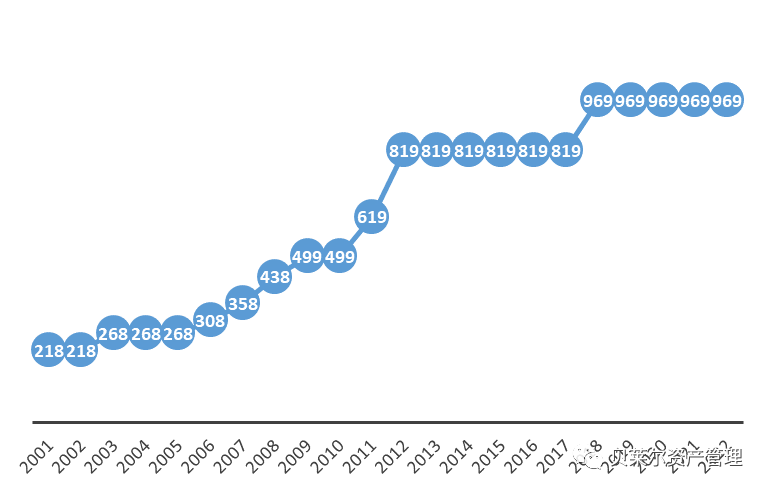

Data source: Listed company announcement
3) Increase in dividend rate
Also due to the lack of money by major shareholders, Moutai's dividend rate increased significantly to 96% last year, sharing almost all of the annual profits! If major shareholders want to eat meat, small shareholders can also eat soup with them. Why not? You must know that low efficiency of capital utilization is one of Moutai's few shortcomings. For a long time, a large amount of idle funds have been lying on the books and can only generate meager interest income. Today, Moutai can still achieve double-digit growth after distributing most of its profits to shareholders. This is equivalent to adding a high dividend yield to the original high growth. What a great business!
4) Valuations dropped significantly
Compared with the price of 50-70 times the current profit in 2021, the current A-share price of Kweichow Moutai has dropped sharply to just over 30 times (of course, this is still not low). We're not sure if it's because of the disintegration of institutions, or"Zhongtegu"Or the AI theme diverted the overly enthusiastic funds before, or for some other reasons. We are rarely willing to pay more than 20 times P/E, but for Moutai, a great brand and special growth machine, this valuation can be said to have entered a relatively reasonable range (note that reasonable does not mean that it will not continue to fall, the stock market sometimes swings like a pendulum, and sometimes it will not).
In the long run, in an era of asset scarcity, as economic growth steps down and M2 rises, funds will eventually chase scarce assets. Moutai, with high certainty, should benefit in the long term.
(Risk warning: 1. Moutai is highly related to M2 but will also be affected by other factors, such as policy risks in 12 or 13 years, and M2 may not always rise, and the risk of deflation is not completely absent;2. Moutai's true bottle opening rate is a mystery, and it is said that it is only 30% or less. If the turmoil causes the price trend to reverse, dealers and investors rush to put the backlog of inventory on the market, it may cause a price collapse.)
5. Tencent Holdings
"The ultimate resource is actually human beings themselves, especially those young people who are rich in skills, high in fighting spirit, full of hope, and love freedom."
- "Growth without Limits", Julian. Simon
Last year, Tencent's share price suffered its biggest Waterloo since its listing, with the largest retracement of more than 70% from its 2021 high. For us, it's like coming to a shopping carnival on November 11 or Thanksgiving Day, with the only difference that the crazy crowd is running outward rather than inward. As a long-term investor, watch"discount sale"Of course, our attitude is to accept it.
The WeChat and its ecosystem created by Tencent's team still have irreplaceable status in people's minds. I remember in the early years, due to some external pressure, everyone began to discuss the issue of choosing between WeChat and Apple's mobile phone, and many forums and platforms (such as Weibo and Zhihu) also released many votes. I thought that facing a giant like Apple and Buffett's hand-picked"Worth giving up the second car"For top consumer goods, a small application of WeChat may be stressful. As a result, I didn't expect that the voting results seen in various places were almost one-sided in favor of WeChat. even the United States"iron Man"Musk has also stated on many occasions that WeChat is too easy to use, and one of his important motives for acquiring Twitter is to turn it into the WeChat of the United States.
In addition to its rock-solid moat, Tencent is also unremitting in building new growth engines. According to the latest released 2022 Annual Report and 2023 Quarterly Report: WeChat's Mini programs and Short Video business"Video number"In the fourth quarter of 2022, the usage time was twice and tripled respectively that of the same period last year; international market games increased by 25% year-on-year in the first quarter of 2023; other advertising, financial enterprise services and other aspects also had many remarkable performances, but this time we would like to take some time to talk about two prominent issues in the past year: major shareholders reduced their holdings and Tencent investment.
In an environment that was already under multiple internal and external pressures last year, major shareholders suddenly broke their original three-year commitment and announced their reduction of holdings. For many investors who have long been scared, this information may be the last straw that crushed the camel. We have received rare inquiries from some friends and investors,"Are major shareholders not optimistic about Tencent's development?","Is there a major internal problem?"。We have always attached great importance to the buying and selling behavior of insiders. We have the following views on this issue:
1) This major shareholder behavior is not that it is not that it is not optimistic about Tencent's development. The market value of major shareholders Prosus and Naspers themselves in the secondary market has long been significantly lower than they believe"intrinsic value"(Calculated through the intrinsic value of the assets held, mainly Tencent shares. The market value of the secondary market was once less than this"intrinsic value"40%)。So major shareholders need to sell Tencent shares and then buy back their own shares to shrink this"unreasonable"Difference;
2) The behavior of major shareholders destroys value to some extent. In theory, the performance of the short-term stock price will not have any impact on the company's value, but when a major shareholder holding more than 30% launches a fully open-ended, time-limited long-term reduction plan, this will inevitably create a long-term pressure that hangs over the market and the company's internal shareholders. One of Tencent's management advantages is its advanced equity incentive plan: sharing the company's growth and stimulating team morale through extensive long-term stock binding, from executives down to new employees who have just arrived. For many Tencent talents (especially core business positions), equity may be an important part of their income source. This style of reduction plan not only has a negative impact on morale, team enthusiasm and employee real income;
3) From the perspective of a major shareholder, the core problem it faces is that as an investment institution, the performance of other investments other than Tencent ranges from unsatisfactory to poor. Tencent may be a rare high-quality asset on the books. It may be reasonable that the market gave him a huge discount. Faced with this problem, the solution given by the major shareholder management is to pick the most prosperous flower in the garden and water the surrounding weeds. From a corporate governance perspective, if management bonuses or incentives are highly linked to short-term stock prices (rather than value), then when the stock price is below the value of the assets it holds, management will almost certainly adopt repurchase, reorganization, spin-off, or"market value Management"Wait for a series of measures to push up the stock price. On the one hand, it can be said that management protects the interests of shareholders. On the other hand, whether these operations effectively use funds and destroy value may be ranked second to the level of stock prices. In fact, the share prices of many listed investment institutions are lower than the sum of their assets, even star fund managers. For example, the stock price of Buffett's Berkshire is often lower than its intrinsic value, while the stock price of the Pershing Square Fund managed by Bill Ackerman discounts more than 20% to the company's intrinsic value (according to the 2022 Pershing Square Letter to Investors).
In addition to the pressure from shareholders to sell, Tencent's investment, which we believe is one of Tencent's most important competitiveness, also seemed to be a bit out of steam last year.
Figure 4. Distribution of Tencent Investment Events, 2011-2022
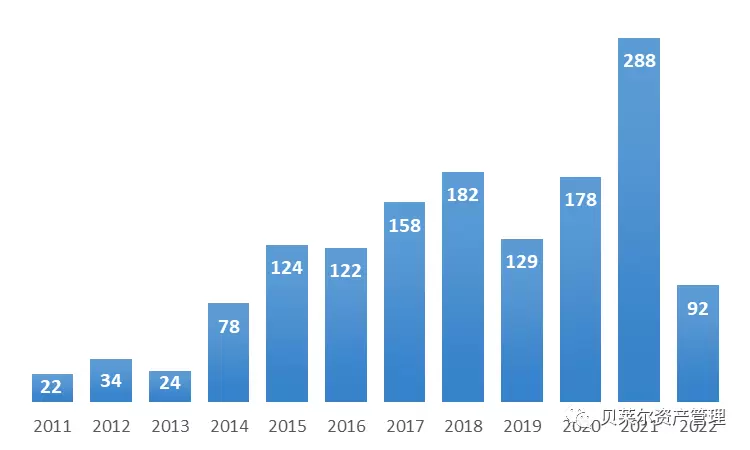
Data source: third-party channel IT Orange
According to the data provided by IT Orange, based on the number of investment sales, the decline will fall to 92 in 2022, a drop of nearly 70%. In the field of games that it specializes in, from more than 60 sales in the previous year to last year, almost no company in China received Tencent investment. Whether you look at the number of investments or the amount invested,"sowing"The pace is slowing down significantly, but"harvest"The rhythm is increasing:
In 2022, Tencent will repurchase a total of 107 million shares at a cost of 33.8 billion Hong Kong dollars. At the same time, it will pay a cash dividend of 23 billion Hong Kong dollars and a physical dividend of 948 million Meituan shares, worth nearly 170 billion Hong Kong dollars (calculated based on the share price of 178 Hong Kong dollars). This is equivalent to giving shareholders back 170% of their net profit! Even if there are fewer seeds now, Tencent still has high-quality companies worth hundreds of billions of dollars in its investment landscape, many of which have quite long-tailed businesses, such as Pinduo, which is expanding the North American e-commerce market.
I am afraid that the above two issues will affect Tencent for a long time, especially changes in investment.
In the short term, the regulatory attitude towards Internet platform companies has changed significantly, and the review and issuance of game copyrights have also been liberalized. In the long run, despite many resistance and constant challenges, the potential of WeChat and its ecosystem is still great, and the opportunities that generative AI may bring cannot be underestimated. At the same time, Tencent still has the best management team in the world. One. So, this is still an unparalleled business and a group of enterprising people.
6. Midea Group
"Before the great changes of the times, long-term doctrine was not a choice, but an intrinsic ability that needed to be accumulated all the time."
- "Midea Group 2022 Annual Report", Fang Hongbo
In 2022, the domestic home appliance industry is struggling under multiple pressures. According to the National Household Appliances Industry Information Center, the retail sales of the air-conditioning market are 141.1 billion yuan, down 8.7% year-on-year, and the retail sales of the washing machine market are 62.4 billion yuan, down 12.6% year-on-year. Midea Group withstood the downward pressure from the macro environment and the industry, achieving revenue of 345.7 billion yuan, flat year-on-year, and net profit attributable to shareholders of the parent company was 29.6 billion yuan, a year-on-year increase of 3%. In the 2023 quarterly report released at the same time, Midea's revenue and profits achieved year-on-year growth of 6% and 12% respectively. Midea's way to break through the gravity of the industry is to be high-end, younger, and TOThe second and third growth curves of B and other development paths:
After three years of development, sales of high-end brand COLMO exceeded 8 billion yuan, a year-on-year growth of close to 100%;
The revenue of Hualing brand, which embraces young people, exceeded 7 billion yuan, a year-on-year increase of nearly 30%;
To The revenue of the B-end Building Technology Division and the Robot and Automation Division was 22.8 billion yuan respectively, a year-on-year increase of 16%, and 27.7 billion yuan increased by 10%. These two growth figures will further accelerate to 41% and 27% in the first quarter of 2023.
These increases came amid Midea's dividend and repurchase of nearly 20 billion yuan last year. In other words, after sharing 2/3 of its net profit, the company can still explore many emerging businesses and achieve growth!
From being among a group of home appliance companies to today, Midea has demonstrated its remarkable evolutionary ability. We believe that the key is long-term management behind it. Look at the top rivals in the field of home appliances at the time: Changhong, the king of black electricity, made successive strategic mistakes, Chunlan, once a role model for air conditioning, over-expanded, and Warburg and Kelon were both defeated by equity disputes between management and shareholders. Under the leadership of founder He Xiangjian, Midea completed the management buyout early and established a modern management mechanism. From then on, management was no longer constrained. After He left office, Fang Hongbo and his senior management team also had high equity binding and sufficient independent business decision-making power. In addition to a management culture that emphasizes performance-oriented and hard-working spirit, during a recent management exchange, we learned that Midea has high ambitions in talent cultivation: it requires each executive to have three reserve candidates, and the current business department The people are all younger born in the 1980s, which shows that their talent echelon is ahead in depth.
Although the pressure brought by the short-term real estate downturn and overseas market destocking cannot be ignored, Midea has demonstrated good evolutionary ability and long-term thinking in management and emerging businesses. We will continue to track and evaluate the development of Midea in old and new fields.
7. Focus Media
"The changes in focus building advertising are like a barometer of China's economic development. Through focus advertising, we can fully understand the wind direction and trend of urban consumption upgrading."
- "Focus Media 2022 Annual Report", Jiang Nanchun
In the past year, Focus Media's performance can be described as unbearable. Revenue fell 36%, and net profit fell 54%. This performance is affected by many factors:
1) Epidemic risk control and macroeconomic prosperity have led to a decrease in building advertising;
2) Competitors are resurrecting, and trendy trends continue to splash porcelain and dirty water to divide the crowd.
We believe that the first factor is a short-term factor. The epidemic has been lifted and the economy will recover sooner or later. Focus's first quarterly report for 2023 has already regained growth. The second factor may be a medium-to long-term factor. The trendy style of self-defeating 800 yuan has a good impact on big brands. After all, advertisers value positioning, just like high-end goods and luxury goods will not sell more goods or advertise. The layout of office buildings in the High-Line City is weak, and large brands will not launch much even if they want to. However, some small and medium-sized brands with insufficient advertising funds may indeed be subject to certain diversion.
We had expected Xinchao to not survive the epidemic. Before the epidemic, it had an annual loss of more than 1 billion yuan. As long as the epidemic lasts for two or three years, it will be difficult for the new trend to survive. Then the crowd can easily expand its share and raise prices. However, contrary to expectations, it received Jingdong financing again during the epidemic, and as much as $400 million, and survived tenaciously through heavy layoffs.
At one point, we wondered why the new wave could survive a sharp downward cycle and make a comeback. It may be that Focus raised prices too fast in the past, and its downstream customers such as Baidu and Jingdong could not afford it, so they supported the new trend to lower the price of Focus. Therefore, Xinchao survived by relying on rounds of financing and burning money, and continued to contain the focus. Perhaps Focus will have to face this new reality, and then this continuously shouting opponent may exist for a long time. Of course, this industry is very big, and the advertising value it provides is unique (otherwise Jingdong would not have spent a lot of money to save trendy products), enough to support two or more players.
This is a good lesson in business. You can defeat all competitors, but when you have oligarchs or giants with strong bargaining power in your upstream and downstream, and you ask too much, they will support your competitors to challenge you or go directly to the field and become your opponent. For example, we see the battle between new energy battery supplier Ningde Times and a number of car manufacturers (GAC decided to create its own magazine batteries after complaining that the price of Ningde batteries was too high) and the divergence and convergence between a number of brands and retailers in the United States.
Back to Focus, we still believe that the media industry is a racing business. Whoever runs fast and grabs more points can build competitive barriers and accumulate exponential advantages. On the cost side and advertisers want to reach larger and more valuable groups, they suppress opponents. Focus, which occupies a wide range of high-quality business district resources, has irreplaceable advantages. With people's pursuit of a better life, maybe we don't know which consumer brand will win in the end, but they may all rely on the power of many Focus Media to achieve more effective communication and create more distinctive brands.
8. Financial sector (Ping An of China and China Merchants Bank)
"Ping An is committed to becoming the world's leading comprehensive financial, medical and health service provider."
- "Ping An China Annual Report 2022"
Since 2008, every year, Ping An's annual report of China has given the focus of the company's future development at the beginning of its annual report. In the past 15 years, although every year has been slightly different, such as more adjectives"international leading"、"technology-based"Wait, but the final position of landing is all"integrated Financial Services Group"。In last year's 2022 annual report, the word became"Integrated financial, medical and health service providers"。From here we can see how determined we are to change peacefully.
Ping An has actually been evolving. The life insurance reform it began to lead the industry in 2018 has improved some last year. We have seen positive changes in indicators such as new business value, agent income, and 12-month policy continuation rate. Next, the life insurance business, which accounts for the largest proportion, should have some exciting performances.
Figure 5. Growth rate of value of Ping An Group's life insurance and health insurance new businesses %
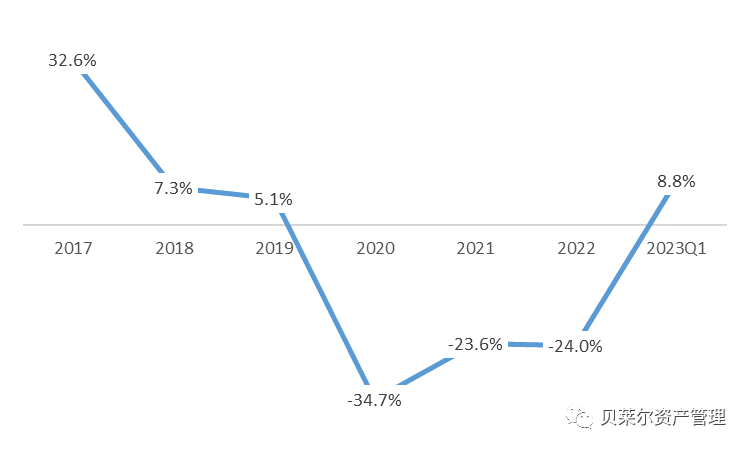
Data source: Annual report of listed companies
In terms of investment that we focus on, Ping An performed poorly last year, with its total investment return reaching a record low of 2.5%, far below the average of 5.3% over the past decade and the long-term investment return assumption of 5%. Although the stock market performed very poorly last year, with the Shanghai Composite Index falling 15%, and the Shanghai and Shenzhen 300 falling 20%, short-term listed equity assets accounted for only a little more than 10% of Ping An's entire 4.4 trillion yuan investment plate. As one of the few long-term institutional investors in the market with continuous cash flow inflows, it should have seized the opportunity to appear more greedy when the market panicked last year, but it did not. Ping An's investment failures in Country Garden, Huaxia Happiness and commercial real estate can surely be written into classic business school cases.
Looking at it from another perspective, even if its investment last year was so bad, the group was able to achieve hundreds of billions of yuan in net profit and intrinsic value growth, which makes people sigh at the excellence of its business model. A successful company like Amazon has also gone through FireTablet (a tablet computer similar to Apple's iPad) is a detour. Coca-Cola also launched failed products like New Cola in the 1980s. When we look back in hindsight, these large-scale business misjudgments are undoubtedly costly, but the long-term cost of staying in your comfort zone without innovation and taking risks may be even higher. Compared with its stereotyped counterparts, Ping An still leads more than one position in reform, medical care and other fields, which is inseparable from its continued spirit of innovation.
In the long run, with the trend of population aging, insurance, medical care and elderly care have great potential. The latter two areas have long-term demand even in Japan after the bubble burst. We still appreciate Ping An's culture of pioneering and innovative development, but we are also aware of the difficult and objective environment for progress in these fields. We will continue to carefully track its developments and changes in insurance, medical care and investment.
In addition, in the financial sector, we also paid special attention to China Merchants Bank last year. Due to the president's incident and concerns about guaranteed real estate delivery, China Merchants Bank was abandoned by the market, its share price broke, and its price-to-earnings ratio once dropped to five times. Since many people around us are customers of China Merchants Bank, we can easily perceive the extraordinary services this bank has been providing. China Merchants Bank has taken a unique development path, insisting on retail and wealth management as its core, and has good competitiveness in the industry.
Investing in financial companies, especially banks, must be particularly careful because of their embedded high leverage and high procyclicality. We believe that China Merchants Bank has performed well in these points:
1) Using the tier-one core capital adequacy ratio as a tool to measure leverage, China Merchants Bank's adequacy ratio is as high as 12.7%, ranking among the best in the industry and even higher than two of the four major banks. An important factor is that China Merchants Bank's customers are of good quality. At the same time, agency fund sales, consignment insurance and other wealth management fee income that it focuses on developing will not consume capital;
2) China Merchants Bank's non-performing loan provision coverage ratio is as high as 460%, which is not only far higher than the 120% required by the CBRC, but also higher than the four major banks (refer to ICBC 210% and China Construction Bank 246%), as well as the vast majority of joint-stock banks. Such a strong provision can serve as a stabilizer for profits during unfavorable economic changes (or hide profits during periods of calm);
3) China Merchants Bank's exposure and risk control in the real estate sector are very strict: the company's new personal housing loans in first-and second-tier cities account for 88% of the total new personal housing loans issued; the ending balance of personal housing loans in first-and second-tier cities accounts for 86.50% of the company's ending balance of personal housing loans.
In terms of unfavorable factors, China Merchants Bank does face some competition in the retail and wealth areas where it is good at. For example, Ping An and Xingye are stepping up their efforts to catch up. At the same time, due to the decline in real estate, the market is worried that banks will also be dragged down. We believe that in the long run, the competitiveness of investment promotion is second to none. In 2022 and the first quarter of 2023, we delivered excellent results of net profit growth of 15% and 7.8% respectively. For an excellent bank with strict risk control, a solid industry position, and continued to grow after paying dividends of 1/3 of its profits every year, and a clean valuation that is only a little over 5 times, our choice is to abandon it.
9. Real estate sector (Vanke Enterprise, China Resources Land, Longhu Real Estate)
"If city government is regarded as a business, then Western cities raise funds by issuing bonds, while China cities raise funds by issuing 'city stocks'(real estate)."
- "The Great Rise", Zhao Yanjing
In the memorandum of the past two years, we mentioned that the real estate industry is entering a new stage, and many companies will encounter trouble, but Vanke, with a sense of crisis, can survive the protracted battle to test survival. The real development of the industry last year cannot be said to have nothing to do with the script we received, but can only be said to be exactly the same. But the changes in the past year have been so rapid and so great that we never expected:
1) The sales area of commercial housing dropped from 1.8 billion square meters to 1.36 billion square meters, and the newly started area dropped from 2 billion square meters to 1.2 billion square meters;
2) Almost half of the top 100 real estate companies have defaulted, and the overall land acquisition has dropped by 60%;
3) Two and a half of the four major real estate companies fell. In addition to defaulting on their debts, the sales area and amount also fell sharply (Vanke rose to second place, and Country Garden is still in the top four with the support of the central bank's three arrows).
Although these changes are shocking, we still believe that the real estate industry will not perish. This is an important industry related to the national economy and people's livelihood, and it is also the main source of fiscal revenue for local governments. Now the policy has reversed, the central bank has reversed."Multiple arrows"All efforts are the most powerful proof. If three arrows are not enough, we believe that there will be a fourth or even a fifth arrow. Secondly, a few top players in the industry will survive and do well, and these players must have a reasonable debt structure (which is certainly what players across the industry need), a strong management culture, and a focus on long-term incentives. Based on these standards, when the industry was pessimistic last year, we added two new targets of concern: China Resources Land and Longhu Real Estate. In terms of price, their market values at that time were significantly smaller than the lower edge of the company's intrinsic value range we calculated. In terms of business, their main projects are all in first-tier and second-tier cities, and their products are aimed at mid-to-high-end groups and have better pressure resistance. At the same time, both operating businesses (commercial real estate, etc.) are developing well. In addition, as a central enterprise, China Resources can more easily absorb its opponents 'share through continuous ammunition delivery in the current environment. When everyone is extremely pessimistic, we tend to be a little more optimistic.
Of course, this does not mean that you can be blindly optimistic. The risks are not completely free. If you are not handled properly, house prices may still collapse. On the supply side, although the supply of new homes has dropped sharply, the supply of second-hand houses has increased day by day, so this may not be as violent as the market expects the supply-side reform of the coal industry. The current tasks of these companies should survive first and show their talents in the next stage.
X. Summary
"Two prisoners looked out through the iron bars of the prison. One sees the quagmire, and the other sees the starry sky."
- I don't know who said that.
Some people say that our current macro environment is like the 1970s in the United States, with high inflation, rising interest rates, and a difficult economy. This statement may also underestimate the extent of the difficulties at the time: the United States was mired in the Vietnam War, OPEC imposed an oil embargo on the United States, President Nixon left the White House due to the Watergate incident, and so on. Pessimists can certainly find other and more evidence to make people worry about the future. Rational optimists know that patience will pay off. In fact, even if all kinds of difficulties emerge one after another and people will always come up with more solutions, the stock market will always hit new highs in the future.
There is no denying that last year was a difficult year, but it was also a year full of opportunities. Among the targets we are concerned about, both the new economy and the old economy have encountered challenges to varying degrees. We seized the opportunity, dared to be greedy when the market panicked, and increased the proportion of these high-quality assets. More importantly, we have seen that these outstanding companies have adhered to their values while consolidating their competitive positions in difficult environments. They actively embrace change, transform and reform, and use huge dividends and buybacks rarely seen in the market to express confidence in the future when they are extremely pessimistic.
Figure 6. Focus on corporate dividends and repurchase
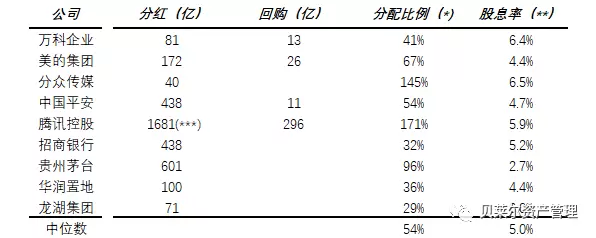
Data sources: listed company annual report, Wind database
(*) The distribution ratio is calculated as (dividends + repurchase)/net profit
(**) Dividend yield is calculated asDividend/stock price, stock price is based on closing price on April 30, 2023
(***) Tencent Holdings 'dividend is 20 billion yuan in cash dividend plus 148.1 billion yuan in physical dividend from Meituan shares (RMB)
Finally, we still use a sentence from Midea Group's annual report last year as our summary.
"We haven't seemed to have gone anywhere in the past year, but we have actually come a long way."
This memorandum ends here. Thank you for taking your precious time to read such a nagging pile of words. If you have any questions, suggestions or criticisms about any content in the memo, please send an email to eugene_tu @ belaircapital.com.cn. Thank you very much.
(Special note: The above analysis is only used as an exchange of methods for studying industries and companies in the past year, and does not constitute a recommendation for buying or selling stocks of Kweichow Moutai, Tencent Holdings and other companies. For companies we have followed in the past year or years, we cannot confirm that we will continue to follow under any circumstances in the future.)
Belair Asset Management Co., Ltd.Tu Shiyang
2023/05/19
 Guangdong public network security no. 44000000000000


