This is the seventh investment memorandum for the fund managed by Bel Air Asset Management Co., Ltd. since its establishment in 2018. In this memorandum, I will introduce the operating overview of the company that has focused on the past year, briefly talk about some of our thoughts on trade wars and artificial intelligence, and discuss TSMC, Tencent Holdings, Pinduo, Ruixing Coffee, Kweichow Moutai, Midea Group and other companies that have focused on it. I hope that through this communication, investors can better understand our investment style, recognize our long-term perspective, and at the same time realize our limitations.
1. Business Overview
Last year, the market was turbulent. As of December 31, 2024, the Shanghai and Shenzhen 300 Index of A-shares, the Windsor A Index and the Hang Seng Index of Hong Kong stocks rose by 15.2%, 11% and 17.7% respectively. The Shanghai and Shenzhen stock markets and the Hong Kong stock markets finally rebounded after falling for three years and four years respectively. Looking back on the past investment cycle, in the midst of market fluctuations, we have always adhered to the core concept of value investment and continuously accumulated top assets with long-term value through reverse layout. This investment logic based on long-term patience and time compound interest gradually shows its potential for return as the market recovers. Review our three core investment concepts:
1. Focus on high-quality enterprises with long-term competitive advantages;
2. Pay attention to management with both ability and political integrity;
3. Buy at a reasonable or cheap price and hold for a long time.
We buy stocks not in the expectation of rapid appreciation in the near future, but as long-term partnership interests of the company. Rather than focusing on short-term stock price changes, we prefer to examine the changes in the company's business results and its intrinsic value under different economic conditions each year. The table below lists the companies we focus on and some of their key operating data over the past year. Since the understanding and calculation of intrinsic value include too many subjective factors, some comprehensive indicators are used here as a medium to measure the company's value.
Figure 1. Operating data of companies we focus on

Data source: Annual report of listed companies
Note: This list does not represent a recommendation or a company's current position. Even if it holds, the proportion may range from 0 to 40%
At the same time, we will also focus on other meaningful companies and assets, such as META, TSM, NVDA, gold, etc.
There is no comparison of the performance of Shanghai and Shenzhen 300 companies this year because the annual reports of relevant listed companies have not yet been completed
2. Trade War, Again!
"If there are only two countries, China and the United States, the United States can completely refrain from free trade with China to prevent the rise of China. But there are still many countries in the world. China and other countries can still rise through free trade. Since we cannot stop China's rise, we should trade freely with China."
- Berkshire Vice Chairman, Munger
On April 2, 2025, U.S. President Trump signed an executive order for "reciprocal tariffs" at the White House, which had a strong impact on the global trade order and added a lot of uncertainty to our investment layout. This is the second time we have discussed this topic. As value investors, we are good at bottom-up company and industry analysis. Obviously, this macro topic has exceeded the scope of our capabilities. But at the same time, we also know that the trade war has become a key variable affecting the global economic landscape, capital markets and the operations of many important companies. Our fund team always keeps track and research. Here we would like to share our analysis and opinions, and try to answer the following questions: 1. Will the U.S. manufacturing industry return? 2. How will China-US and the world trade evolve? 3. The worst possibility?
1. Will U.S. manufacturing return?
Trump has two main purposes in launching this trade war. Let's assume that the real purpose is what he said. One is to resolve the trade deficit, and the other is to reverse the long-term downward trend of manufacturing and revitalize domestic manufacturing.
Regarding the first target, the trade deficit, a very important reason is that China cannot buy the products it wants to buy, such as the Nvidia AI accelerator H20, which has just been included in export controls (this is a reduced version specially designed for the China market). The sales of this product alone can reach tens of billions of dollars (note that even if the US company Nvidia occupies the vast majority of the interest chain, it may not be considered a direct export from the United States in terms of logistics. Just like Apple's mobile phone's main profit is not in China, but it is considered an export to China). Another reason is that although the GDP of the two countries is not far apart, the gap in disposable income is quite large (it can also be seen here how distorted figures such as GDP and trade import and export volume are to measure the wealth of a country and its citizens).
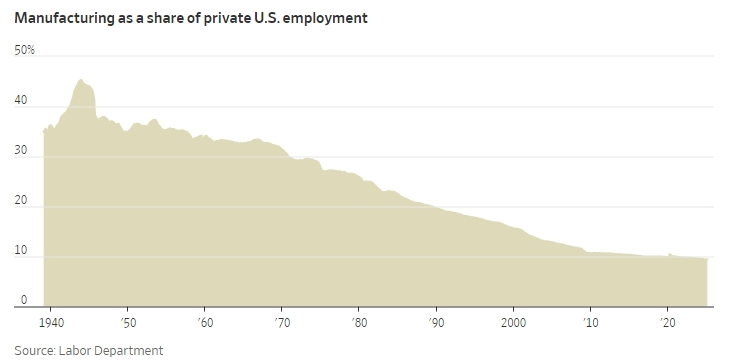
Let's look at the second goal, revitalizing manufacturing. First of all, where was the origin of the decline in manufacturing? Many people will say that China joined the WTO and the World Trade Organization in 2001, and some people with ulterior motives will emphasize that someone stole their manufacturing jobs, but in fact? Let's take a look at this picture.
Figure 2. Proportion of U.S. manufacturing employment since 1940 ( %)
Data sources: Wall Street Journal, U.S. Bureau of Labor
In the 1940s, about 45% of U.S. private sector jobs were in manufacturing, and have continued to decline since then. When China entered the market in 2000, this ratio had dropped to only about 15%. Today, there are 12.8 million manufacturing jobs in the United States, accounting for only 9.4% of private sector jobs. So if all the jobs were stolen, who stole the 30% of the jobs that disappeared between 1945 and 2000 before China entered the WTO? Similarly, the proportion of farm workers in all the U.S. labor force dropped from 80% in 1810 to 40% in 1900, and to less than 1.4% today. Who stole these 80% of farm jobs? Why not revitalize agriculture?
Could there be other reasons?
After the 1950s, the status of manufacturing in the U.S. economy began to decline. Despite the occasional ups and downs during the economic recession and recovery, the trend and speed of unilateral decline in the proportion of manufacturing employment have remained basically stable, and there is no China Shock pulse. During this period, consumer spending shifted more towards services such as tourism, finance and medical services. In fact, it is not difficult to understand that as Americans become increasingly wealthy, the number of refrigerators and cars they can buy is limited, so they begin to buy more services. Jobs naturally change as consumer spending shifts, and more and more people are entering service industries such as banks, funds, law firms, hospitals, software and design companies (these are all enviable high-paying occupations!). The market economy is so wonderful.
From a rational perspective, at this stage of development, manufacturing may not be allowed to return to the United States on a large scale (in fact, the U.S. manufacturing output value is still the second largest in the world). Look at Japan, where the government dominates the industry. Since the 1990s, manufacturing has spread all over the world. Toyota, Honda, Toshiba, Uniqlo and other companies have conquered the United States, Europe, Asia and even the world, but it has not prevented it from missing out on computer, Internet, mobile Internet and other rounds of technological revolutions, as well as the lost three decades (or three decades of low growth after maturity). It is worth pondering that if the United States did not have a strong service industry (venture capital, law firms, etc.), would there be Silicon Valley? If there was no magic square capital, would there be Deepseek?
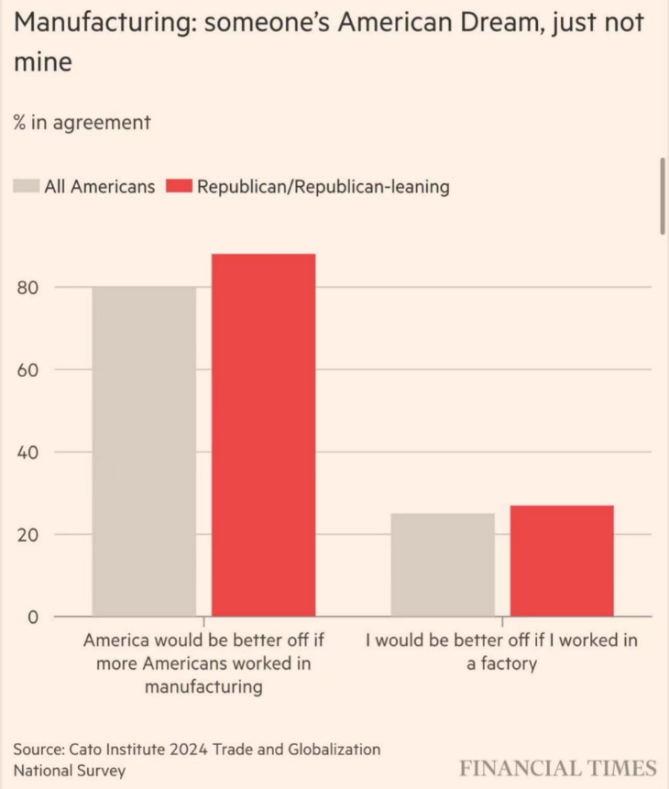
What about emotionally? Could it be that everyone is now enthusiastic and wants to rejoin the manufacturing industry that their fathers and ancestors worked hard? Let's take a look at this Financial Times survey:
Figure 3. Manufacturing: Someone's American Dream, but not mine
Data source: Financial Times
The chart above shows the percentage of Americans agreeing with two views:
View 1:"Ifmore AmericansAmerica would be better off in manufacturing ": There is a contract among all Americans80%Agree with this view.
Viewpoint 2:"IfII'd be better off working in a factory ": There is a date among all Americans25%Agree with this view.
80% of Americans want more Americans to work in manufacturing, but only 25% want to work in manufacturing themselves. This to some extent reveals the current cognitive paradox of American society towards manufacturing. We believe that the return of U.S. manufacturing may be difficult to realize, and the "American Dream" of manufacturing may only stay at the macro narrative level.
2. How will China-US and the world trade evolve?
How will Sino-US and world trade evolve? At present, Canada, the European Union, and China have all carried out countermeasures and adjustments. Will all parties continue to retaliate and escalate, or will they negotiate quickly, or will they continue to pull each other for a long time? Even if an agreement can be negotiated, will he change his mind later (don't be too surprised, Trump tore up the US-Canada-Mexico agreement he had negotiated before as soon as he came to power)? How will other trading partners respond?
Does anyone know the answers to these questions? Does Trump, the initiator of all this, know? At one press conference, he smiled and said to the camera, I don't even know what I would do, how could you guess? Looking at everything, does Federal Reserve Chairman Powell, who has the latest and most comprehensive macro data, know? At a recent press conference, he said that the uncertainty was too high and he could only sit tight. I am afraid no one can have an accurate answer to how the next development or outcome will occur.
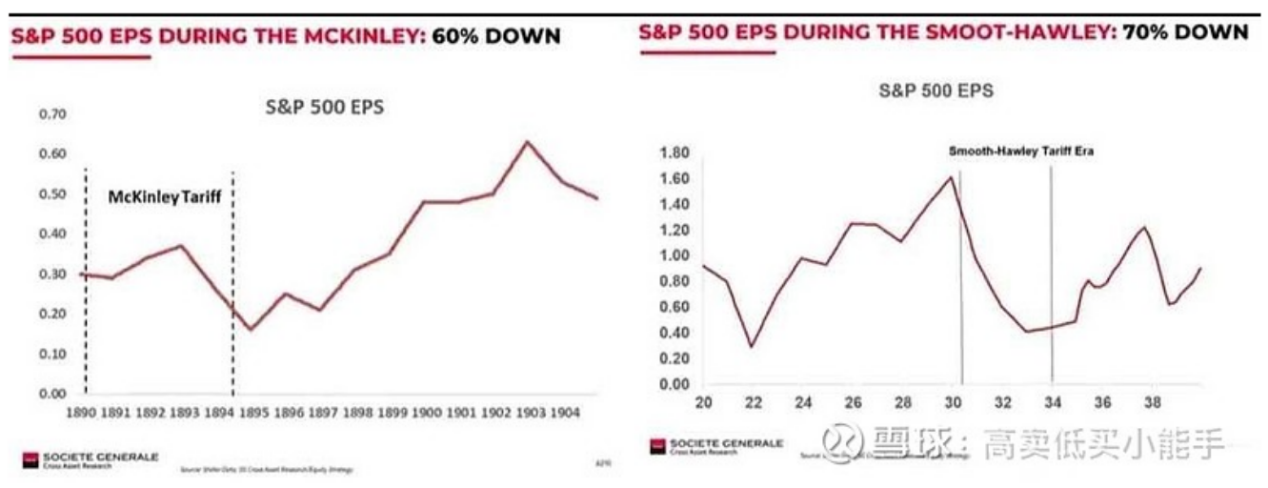
Assuming that the high tariff policy is implemented and lasts for a long time, referring to two similar policies in the United States in history, it is estimated that it will have a significant impact on American companies:
The McKinley tariff was introduced in 1890 to protect domestic industry from competition from cheap foreign goods. The S & P 500 EPS fell sharply in subsequent years.
The Smoot-Hawley Tariff Act was introduced in 1930 with the original intention of protecting American farmers and other industries from foreign competition. As a result, U.S. imports plunged 66%, exports fell 61%, unemployment climbed to 25%, and the S & P 500 EPS fell sharply. There were other deeper causes of the Great Depression (such as deflation), but the tariff bill is widely believed to have exacerbated the recession and slowed down recovery.
Figure 4. Trend of EPS (earnings per share) of S & P 500 companies before and after two tariff policies
Data sources: Snowball, a small expert in selling high and buying low, Societe Generale
It is clear that although large-scale protectionist tariffs that go all the way may bring short-term political benefits, they will harm corporate profitability and overall economic performance in the long run.
In addition, although we cannot predict the trend and outcome of this trade war, we are certain of the following points, and we believe that everyone may need to be prepared:
For some time to come, from four years to longer, we will live in a trading world that is less friendly than before;
In the past, the WTO, most-favored-nation treatment and other non-discriminatory frameworks, as well as the friendly way of resolving disputes according to certain rules under the framework, will be gone forever (at least for the United States and the world, and the world to the United States);
The United States will use the power of a great power to negotiate on-one, or rather,contest("I have cards in my hand, do you have cards?"), to maximize unilateral interests ("America First");
Once tariffs are added for a period of time, they are difficult to remove. Biden did not take away the tariffs imposed by Trump's first term after taking office, and he has not taken away now. People will get used to tariffs, and companies will respond according to tariffs. When you want to remove these protective measures after a while, you will face obstruction from the groups that benefit from protection.
This may be the reality we have to face. In this situation, we tend to think about the worst possibility, and only by surviving under the worst possibility can we be qualified to travel through the cycle.
3. The worst possibility?
What will happen if tariff escalation continues to evolve into substantial trade decoupling? Let's look at an event that occurred in history. This is a real case we wrote in our 2019 investment memorandum, and we will review it again here:
In March 1959, then-U.S. President Eisenhower announced a quota measure on U.S. oil imports, thereby controlling the proportion of imported oil in the total U.S. oil consumption at 12%. This mandatory oil import quota plan is particularly difficult for oil exporters from Venezuela and the Middle East unloading oil at U.S. East Coast ports. Basically, it can be said that the United States has closed the door to oil trade with the Middle East and other places. This did achieve the results the United States wanted in the short term (1960s). Due to the decrease in foreign oil competition, the profits of domestic oil companies in the United States have increased significantly and maintained a certain oil production capacity. This has also enabled the United States to speak more confidently on the international stage without worrying about the sudden cut off of key energy supplies.
So, how do countries such as the Middle East that are blocked from trade respond? In September 1960, they joined forces with countries affected by the policy to form the "Organization of Petroleum Exporting Countries", also known as OPEC today. OPEC's original intention is to coordinate and unify the oil policies of member states, maintain price stability in the international oil market, and ensure stable income for oil-producing countries. After uniting more than 80% of the world's countries selling oil, OPEC not only controlled production, but also increased global oil prices and successfully achieved its goal. On the other hand, in the United States, after entering the 1970s, the energy crisis became worse due to the rapid consumption of oil supply and high oil prices. Later, the United States was almost in stagnation throughout the 1970s, the beautiful 50s bubble burst, and the economy struggled.
In the long run, the United States 'mandatory oil import quota plan has not only failed to plunge oil exporting countries into an abyss, but has also helped promote them to establish an OPEC alliance with the outside world, and has also greatly reduced its ability to cope with foreign oil pressure.
Through this similar case, we have reason to believe that there is a margin of safety for the sustainable development of China's economy in the future.
A key factor in the margin of safety lies in China's economic and trade relations with Japan, South Korea, Australia, New Zealand, Europe, Canada, South America, Southeast Asia, Africa and other developed and developing economies.As long as we actively expand mutually beneficial and in-depth exchanges with other economies and do not play tricks, it will be difficult for the United States to exclude us from the world's major economic and trade circles. And as we continue to contribute to global economy, trade and peace, other economies will welcome us as an important player on the global stage.
Another factor in the margin of safety is that the United States relies more on China goods than China relies more on American goods.According to analysis by third-party securities firms, more than 70% of the supply of 36% of imported goods in the United States (mainly communication equipment, mobile phones, toys, etc., approximately US$160 billion) rely on China, which means that even if tariffs are significantly increased, it will be difficult for American companies to find alternative supplies in the short term. In contrast, in China, only 10%(US$140 billion in major transportation equipment, aircraft, spacecraft, etc.) of its imports are highly dependent (exceeding the 70% threshold) on U.S. importers. More than half of U.S. imports account for less than 30% of the China market. Perhaps contrary to what many people think, U.S. consumers will be hit relatively more by the escalation of tariffs.
Careful readers may have noticed that last year we had a chapter with a similar title,"3000 Points of Defense, Again". The pessimistic atmosphere at that time was not less than it is today, and we believed that China assets were a rare valuation depression around the world. At the same time, we expressed that since well-known American funds were quietly buying China assets, could we also be a little optimistic about the future?
This year's trade war has brought a high degree of uncertainty. We believe that the essence of a trade war is the redistribution of global economic power. If an extremely unfavorable situation occurs, the direct impact on export manufacturing and the indirect impact on the economy and employment cannot be underestimated. But this may also stimulate us to more actively build a "dual circulation system", carry out income distribution reform, and significantly increase residents 'disposable income.
There is often a golden window for value discovery in drastic changes. We must maintain strategic focus and embrace certainty amid uncertainty. Just as after the sharp decline in the trade war market in 2018, China's assets recovered their lost ground in less than a year. In the face of long-term doctrine on a year-on-year basis, is it possible that the current fluctuations will end up just a footnote on the return curve? Even in the face of huge waves, we believe in the Chinese national spirit of the foolish old man moving mountains, carefully guarding and filling the sea, and Kuafu chasing the sun. We also believe that human beings 'pursuit of efficiency improvement and cooperation and prosperity will only be late and not absent.
3. Artificial intelligence
"The bland horse-less carriage (car) has now become a luxury for the rich; while its price may fall in the future, it will certainly never be as popular as bicycles."
- Literary Digest, October 1899
In the past year, artificial intelligence (AI) technology has begun to fully penetrate into the industry and rebuild social productivity. From technological breakthroughs to scenario implementation, from policy support to the evolution of the global competitive landscape, AI is reshaping the global economic landscape at a faster rate than expected. For AI practitioners and investors, a key event is that Scaling Law, the core theory that supports the rapid development of the AI field, hits a wall.
Scaling Law hits the wall
(Background: Scaling Law means that as the size of model parameters, the amount of training data, and computing resources increase, model performance will improve accordingly, and usually follows the rule of power-law growth.)
In 2024,"Scaling Law" will encounter major challenges. The release of new-generation models (such as GPT-5 and Gemini 2.0) by leading companies such as OpenAI and Google has been delayed due to bottlenecks in data, computing power and energy consumption. The industry generally believes that the traditional "parameter stacking" model has reached its limit. Ilya, former chief scientist of OpenAI, mentioned in a forum that the world's high-quality text data was nearly exhausted, and later even used the word Plateaued to describe the progress of pre-training Scaling Law in an interview with Reuters. This is due to:
The input-output ratio is seriously unbalanced.As the scale of the model continues to expand, the trend of diminishing marginal benefits becomes increasingly significant. The training cost of ultra-large models is rising exponentially. Training a very large model may cost hundreds of millions of dollars in computing power costs, as well as massive high-quality data collection and labeling costs. At the same time, performance improvements have become extremely slow.
Data bottleneck problems are gradually becoming prominent.High-quality data resources suitable for model pre-training are close to exhaustion. Currently, most of the data such as text and images that are easy to obtain and organize on the Internet have been used for model training. New data acquisition is difficult, costly, and of uneven quality.
In our view, these are objective problems that exist in the short term, but will be solved in the long run. First, the application of killer weapons to meet output requirements requires patience. The most successful mobile app, WeChat, was first tested four years after the iPhone came out. The first commercial PC (personal computer) came out in 1975, and Windows, which made it fully available to the public, was not launched until ten years later, in 1985. Secondly, the data is obviously far from the bottleneck. Artificial intelligence cannot stay at the text level, it is just a text chat robot. Just like our children, they know and learn the world (train their brains). They never just through words. They have hands, feet, mouths, noses, ears, and eyes. Sooner or later, these similar data will be developed and fed to artificial intelligence models.
Moreover, short-term problems also have short-term solutions. If pre-training Scaling fails, people can try to put Scaling to another stage. The Reinforcement Learning post train is to scale more high-quality inference data without significantly increasing parameters in the post-training stage. Test-time compute is the number of times the inference is scaled to achieve a more reliable output. For example, after OpenAI released the o1 model,"Scaling Test-Time Compute" became an important research direction in the AI field. The o1 model divides big problems into a series of small problems (i.e. Chain-of-Thought), allowing the model to think step by step like a human being, conducting evaluation, planning, and self-reflection before giving answers. That is the "deep thinking" option in our common AI dialog box now. So even if pre-training suffers short-term setbacks, the Scaling Law of "working hard" still plays a role in different places.
At the same time, the perhaps more important Moore's Law/Huang's Law has not failed:
Moore's Law and Huang's Law of Relay
Moore's Law: The number of transistors integrated on a computer chip of the same area doubles every 18 to 24 months.
Wong's Law: Named after Nvidia CEO Huang Renxun, it predicts that GPUs will double AI performance year by year.
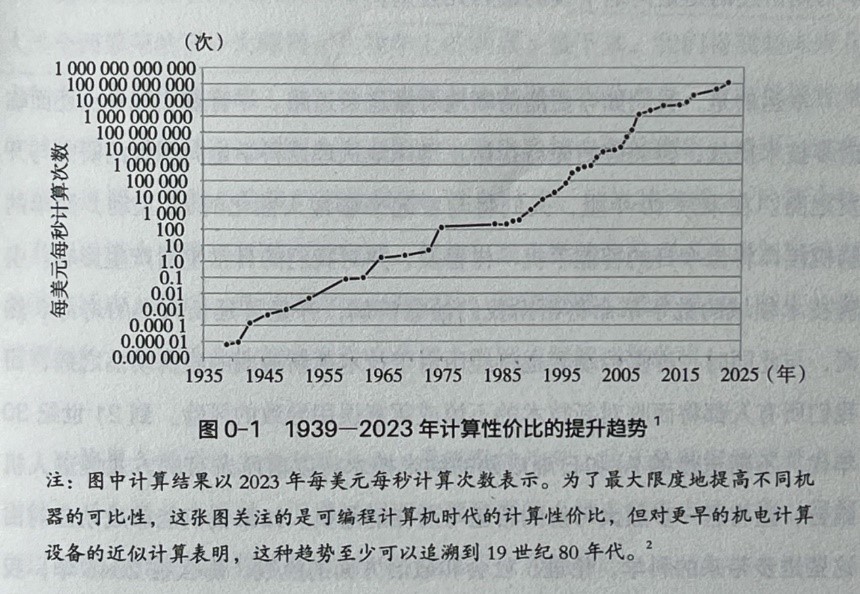
These two laws are essentially examples of the law of accelerated returns. In fact, before Moore's Law, the cost performance of calculations led by vacuum tubes and transistors also increased exponentially. In Kurzweil's book "The Singularity Closer", it reveals a shocking truth behind the semiconductor field:
Figure 5. Improvement trend of computing cost performance from 1939 to 2023
Data source: "Singularity is closer"
In the long run, the computing power that one dollar can buy has always increased exponentially over time, or the cost of computing power has declined exponentially. Don't underestimate the power of this rapid cost reduction. Looking back at history, the world's first car, the Mercedes-Benz-1, was born in 1886. For a long time after that, the total number of cars in Germany was only more than 30,000, and horse-drawn carriages were still the dominant factor. The turning point came more than 20 years later, in 1908, when Ford's assembly line significantly reduced the price of cars from $2000 to $850 (a 60% reduction), and cars began to spread rapidly. Therefore, at the beginning of the year, many people regarded the emergence of Deepseek's ultra-low-cost model as a downward turning point for computing power companies such as Nvidia, and may have misdirected the direction (this is the direction of industry development, not the direction of short-term stock prices). Only when costs continue to fall can new things "emerge".
We have reason to believe that this law will remain valid for years to come. Even if pre-training Scaling is frustrated, the AI field still shows a strong development trend. Whether it is the depth and breadth of technological breakthroughs or the continuous expansion of application scenarios, it indicates that AI will play an increasingly critical role in future economic and social development. So how can investors find investment opportunities in this exponentially growing technological revolution?
We prefer to look for high-certainty opportunities among winners who have already won.Just like Buffett, a few years after the iPhone went public, he only began to invest heavily when the industry was completed and the competitive landscape stabilized. At present, in the entire artificial intelligence industry chain, we are not sure whether their investment and efforts in artificial intelligence in application-side companies such as Tesla, OpenAI, Deepseek, and ByteDance can ultimately make money and how much money they can make. But what we can be sure is that the semiconductor industry led by Nvidia and TSMC will most likely benefit a lot in this process. As "sellers" of AI chips, they will benefit from the continued growth of the industry in the long run. (We discussed Nvidia's competitive advantages in last year's annual memorandum, and the next chapter will briefly share our views on TSMC. Note that this is not a recommendation. NVIDIA and TSMC are both companies with the highest cyclical performance in history.)
Deepseek and OpenAI
The past year was not only the "year of collision with the wall" for the old model, but also the "year of breaking the situation" for the new forces. From the reflection of Scaling Law to the rise of DeepSeek, the industry is shifting from "barbaric growth" to "intensive farming".
DeepSeek, which we mentioned in our memo last year, shines this year. On January 20, 2025, DeepSeek officially released its high-performance AI inference model R1, which shocked the world. The model performs well in tasks such as mathematics, code, and natural language reasoning. Its performance is directly benchmarked against OpenAI's o1 and is open to developers around the world in an open source form. At the same time, the price is less than 1/10 of that of OpenAI o1. With limited computing power, funds and other conditions, DeepSeek has achieved an order of magnitude lower training and reasoning costs by optimizing software, algorithms, etc., demonstrating strong technical competitiveness and innovation capabilities. We continue to like the DeepSeek team!
OpenAI is no worse. Its newly released o3 and o4-mini have begun to support the reasoning model of "image thinking", which can deeply integrate visual information into the logical chain. In the various tests they participated in, whether it was difficult mathematical competitions, multimodal benchmark tests, or programming competitions, the models have reached unprecedented heights, demonstrating capabilities that are comparable to or even surpass top experts.
In addition, we have also seen that AI agents have become a new business format derived from AI technology by realizing the leap from language understanding to autonomous execution, representing the next wave of AI development. From emerging technology pioneers such as OpenAI, DeepSeek, and Manus to traditional technology giants such as Google, Byte, Ali, and Tencent, they are all deeply involved in this industrial transformation and comprehensively layout the R & D and commercialization of agent technology. As an investor, I am deeply shocked and admired to see many entrepreneurs and entrepreneurs continue to push artificial intelligence technology to new heights with enthusiasm, and transform cutting-edge technologies into innovative products and services to market.
4. TSMC
"Looking at the world's top Foundry, only TSMC dares to invest heavily in building huge production capacity without any orders. You must know that the construction of a fab will take more than four years. The original investment per 10,000 chips at 7nm was about US$2.5 billion., and at 2nm, it is as high as more than US$7 billion. TSMC Fab 20A plans to have a 120k production capacity. Nearly 100 billion US dollars will have to be invested in a single factory. In the future, the amount of node investment will become larger and larger. I would like to ask, we must start planning and gradually invest hundreds of billions of dollars four years ago, and build a new factory for the next generation every two years. It must never stop. Which founder dares to invest a lot of money four years in advance without any customer orders? But if you hadn't invested heavily four years ago, even if you had good craftsmanship and customers were willing to place orders, you would eventually lose the order because you had no production capacity and could not supply goods."
- Mr. Wu Zihao, an expert in the semiconductor industry and front-office SMC engineer
TSMC may be one of the most certain options in the AI field from a commercial perspective. Its core competitive advantages include:
Unshakable technological leadership: TSMC leads Samsung and Intel in 3nm/2nm process R & D and mass production progress, grasps the high-yield mass production capabilities of EUV lithography machines, and leads advanced packaging (such as CoWoS, SoIC) technologies;
Long-term customer binding and market capabilities: The world's top technology companies (Apple, Nvidia, AMD, Qualcomm, etc.) rely on TSMC for OEM, especially in the AI chip field (Nvidia, AMD) market share exceeds 90%;
Huge production capacity and investment courage: Dare to be ahead of its competitors several years ago, invest huge amounts of money in advance to build production capacity and lock in customers.
Of course, there are deep-seated reasons for achieving today's unparalleled status. We continue to quote the analysis of industry expert Mr. Wu Zihao:
What we have seen so far is that Samsung and Intel have adopted a conservative strategy in advanced processes, that is, only maintaining tens of thousands of mini line investment to ensure that the process is competitive and then increasing investment. However, the semiconductor construction cycle is too long. If one day Intel's process returns to glory and catches up with TSMC, and quickly places orders to equipment manufacturers to start building new production capacity, it will take two years. In the past two years, there is only the original mini line production capacity, let alone competing orders with TSMC. Even Intel has to place orders for TSMC's own chips. Production capacity will be an unsolvable vicious cycle for backward competitors. This is an important feature of the semiconductor foundation industry.
Therefore, TSMC's position will be even more difficult to shake in the future, because in the past, it only required PK process technology, but now in addition to process technology, it also requires PK advanced packaging, heterogeneous and heterogeneous integration, and ultimately there is an unshakable moat of huge production capacity. And these factors, without exception, TSMC is far ahead, and the gap in every item is still widening, not one or two of them, but all aspects are expanding their leading edge. This technological change in semiconductor manufacturing will be led by TSMC. It will be difficult for the original two competitors, Intel and Samsung, to follow up. Due to lack of orders, they will no longer be able to continue to invest in the huge and extremely expensive production capacity arms race. They will gradually be eliminated in the competition for advanced processes, and the winner-take-all situation of advanced processes will become more serious after competitors are unable to invest.
In terms of growth, we expect AI-related demand (AI GPUs, ASICs, HBM controllers, etc.) to continue to grow in the next few years. The company's internal model predicts that AI demand will grow at a compound annual growth rate of more than 45% in the next five years after 2024. However, pay special attention to the fact that internal forecasts are always prone to over-optimism. In fact, the capital expenditures of downstream CSP cloud vendors all show signs of slowing down in the short term (when capital expenditures have reached 60% of net profit, there is not much room for further advancement in the short term).
Despite the risks, TSMC remains an irreplaceable cornerstone of the global semiconductor industry:
High conversion costs: No company can shake its advanced process OEM status in the short term, and its customer stickiness is extremely strong.
Geophysical "safe-haven asset" attribute: Under the Sino-US game, TSMC has become the target of competition between both sides, and its strategic value has been further enhanced.
We tend to think that AI will change the world, but we also know that people tend to overestimate the short term and underestimate the long term. At present, the pattern and certainty of selling shovels are the best, but we cannot overestimate the prospects of selling shovels. If the miners cannot find gold, the shovel sellers will fall. In the entire AI field, from downstream applications to upstream sales of shovels, I think the next core contradiction may be to see whether the C-side killer application comes first or whether the big economic macro cycle comes first. In an environment of continued trade frictions, the development trend of the AI industry will face more uncertainties and fluctuations.
Special risk warning: Downstream capital expenditures may slow down in the short term; Nvidia and TSMC have strong cyclical fundamentals and strong cyclical valuations. Historically, stock prices have fluctuated violently, with the largest drop of 80%, requiring high margins of safety; Be alert to extreme geopolitical risks.
5. Tencent Holdings
"A speck-sized bee brain only has 6 days of memory, while the hive as a whole has 3 months of memory. The magic of swarm thinking is that there is no bee controlling it, but there is an invisible hand, a hand that emerges from a large number of members, that controls the entire swarm."
- "Out of Control", Kevin Kelly
For the whole year of 2024, Tencent achieved revenue of 660.2 billion yuan, a year-on-year increase of 8%; operating profit of 208.1 billion yuan, a year-on-year increase of 30%; non-IFRS net profit (Non-IFRS) of 222.7 billion yuan, a year-on-year increase of 41%; A cumulative repurchase of HK$112 billion in 2024. In addition, Tencent also holds investment assets with a book value of 817.8 billion yuan and a market value of 948.2 billion yuan.
In terms of AI, in last year's memorandum, we mentioned:
Tencent is the candidate with the most potential to launch artificial intelligence personal assistants (the interfaces of various Mini programs such as ordering, travel, and services are ready, and only a smart agent needs to call them all). We believe Tencent can seize the opportunity.
Unfortunately, not only did Tencent's agent not appear, but even the large mid-level model was slow. In the wave of technology, managers of mature enterprises are often constrained by organizational structure and performance appraisal, and tend to avoid high-risk decisions. Entrepreneurial teams, on the other hand, are driven by disruptive innovation and often have to bear extremely high opportunity costs, and even rely on personal credit, real estate and all resources they can mobilize. This kind of game mechanism of breaking the bridge determines the unique advantages of entrepreneurs in the field of breakthrough innovation.
Fortunately, the DeepSeek-R1 model was born in January this year, activating Tencent's entrepreneurial spirit. With its performance, complete open source attributes and national-level brand recognition comparable to OpenAI o1, this model has prompted Tencent to adjust its strategic direction at an unusual speed. After intensive discussions during the Spring Festival, the company's general office worked together to promote the access of all business lines:
Technology side: Tencent Cloud took the lead in launching API interfaces to achieve enterprise-level deployment;
Product side: Intelligent workbench ima, AI assistant Yuanbao and other rapid integration model capabilities;
Ecological core: WeChat Souyisou launched grayscale testing on February 16, directly calling DeepSeek-R1 's in-depth reasoning function, and integrating closed data sources such as public accounts and video numbers to improve search quality.
This multi-pronged advancement speed reflects the explosion of Tencent's organizational execution power, leaping from the dormant posture of a "follower" in the past to a proactive and leading change posture.
Looking forward, we believe Tencent has two major advantages:
1. Ecology and data moat.The WeChat ecosystem's 1 billion DAU users, public account/video account content pool, Mini programs service matrix and payment system provide closed-loop scenarios and data fuel for AI applications. For example, DeepSeek-R1 breaks through the limitations of Chinese Internet data silos by accessing exclusive WeChat content and significantly improves search accuracy. This triangular closed loop of "data-scene-user" is a structural advantage that competitors such as Baidu and Alibaba are difficult to replicate. For another example, on April 17, Yuanbao AI Assistant connected to WeChat, and users can directly add it as a contact through WeChat. If we use the analogy of a "file transfer assistant" with more than a quarter of WeChat users, Yuan Bao has the potential to become a top contact for 300 million users. This may be a dimension reduction blow for the number one player in the industry with tens of millions of active users.
2. Complementarity of the management team.The product manager culture led by Ma Huateng (such as polishing user experience details late at night) forms a strategic synergy with the long-term investment philosophy led by Liu Chiping. The former ensures that the implementation of technology meets the real needs of users, while the latter strengthens ecological collaboration through capital operations (such as migrating investment experience in game studios to the AI field). This two-wheel drive of "product + capital" played a crucial role in Tencent's historical transformation period (such as the opening strategy after the 3Q War).
Despite its significant advantages, Tencent still needs to be alert to the dilemma of innovators in this uncertain technological revolution. History tells us that resource advantages do not always determine the outcome, and may even become a burden. The QQ team failed to launch WeChat, while Zhang Xiaolong's team successfully built WeChat based on its deep understanding of user needs; in the field of Short videos, despite Tencent's huge investment, it failed to shake Douyin's position; many of the world's most resource-advantageous countries (mostly in South America and Africa) have long been lagging behind, while small countries with scarce resources such as Singapore, the Netherlands, and Switzerland have developed economies.
Even though Yuanbao has ranked in the top three, at this stage, its essence is still a chat robot. In this competition for paradigm change, many key elements will profoundly affect the competitive landscape. On the one hand, recruit top AI scientific talents and build a strong AI team. On the other hand, AI capabilities are deeply integrated into high-frequency application scenarios such as social, advertising, games, and payment under the WeChat ecosystem to achieve seamless connection between AI technology and multiple business scenarios, thereby tapping its potential business value and user experience optimization space. And most importantly, creating native AI applications, such as agents, or opening up new AI portals to expand the application boundaries and innovation models of AI technology are decisive factors that dominate this technological revolution.
We will continue to pay attention to Tencent's development in its core business, artificial intelligence and investment fields.
(Risk warning: The risk of Tencent's business being disrupted is particularly important during the period of paradigm shift, such as Microsoft, which missed the mobile revolution)
6. Fight more
"The energy of the sun is hundreds of thousands of times that of lasers, but due to dispersion, it becomes warm sunlight that human skin can enjoy. The lasers gain energy through focusing and easily cut hard diamonds and steel plates. If companies and brands want to gain competitiveness, they can only focus."
- Zhang Yun, General Manager of Reese Partners China
As a subversive of China's e-commerce industry, Pinduo is reshaping the global retail ecosystem with the "extremely low price" strategy. Its core logic stems from the underlying law of the retail industry-completing transactions at the lowest cost. This concept is highly consistent with nature's "minimum action principle". By restructuring the supply chain, directly connecting factory production capacity to consumer demand, the company focuses on low-price strategies, forming an unshakable mental barrier, especially in the context of deflation cycles and overcapacity.
In 2024, Pinduo will continue to demonstrate strong financial capabilities and growth potential. Its annual revenue will be 393.8 billion yuan, a year-on-year increase of 59%, and its net profit will be 112.4 billion yuan, a year-on-year increase of 87%(calculated according to non-GAAP 122.3 billion yuan, a year-on-year increase of 80%).
Although its performance is strong, Pinduo currently faces at least four major internal and external challenges and uncertainties:
Management strategy adjustment: In order to optimize long-term competitiveness, or for other reasons, proactively shrink profit margins to optimize the platform ecosystem;
National compensation impact: The national subsidy policy is more conducive to Jingdong and Tmall, impacting the original market structure and company operating strategies;
International tariff barriers: U.S. tariff barriers have significantly increased Temu's commodity export costs and operating burdens;
The United States further suppresses: Chinese stocks may face delisting risks or U.S. capital investment restrictions.
These many factors do weaken performance visibility and amplify stock price volatility. But in the world of value investors, volatility has never been synonymous with risk. What Pinduo is showing at the moment is this classic scene of "rough waves on the surface and solid undercurrents on the bottom". Despite the superposition of multiple uncertainties, the short-term fog has created a rare cognitive gap for long-term investors.
From the perspective of a commercial moat, Pinduo has demonstrated amazing combat capabilities.Its domestic main station continues to consolidate its positioning as "extreme cost-effective" and continues to grow amid the attack of giants such as Alibaba and Jingdong, and its return on net assets remains at a high level of 30%+. Although Temu's global expansion encountered regional and (possibly) periodic regulatory headwinds, it successfully delivered China's manufacturing efficiency to 85 countries and regions around the world, building a new generation of cross-border retail infrastructure.
The valuation dimension further interprets the margin of safety.Even if the value of Temu's business is reduced to zero (note that Temu is currently only having high tariffs in the United States), based on the domestic main station alone, the price-to-earnings ratio corresponding to the current market value is in single digits. Such pricing obviously overdiscounts short-term fluctuations, but ignores a long-term fact: this is a continuously evolving super-organization that has won in China's most competitive environment and made overseas expeditions. Considering that its book net cash reserves are 200 - 300 billion yuan, this creates a rare asymmetric structure: it not only enjoys stable cash flow from fast-growing businesses, but also obtains free options to change the global e-commerce landscape. Even if the worst-case scenario were to lose the U.S. market, there would still be 7.7 billion other people in the global market.
Finally, top talents are always paranoid. They may not say what you want to hear, but they may do something crazy, world-changing. As for whether investors who can penetrate the fog of uncertainty and see the essence of value can ultimately gain something, let us wait and see.
(Risk warning: Temu, Pinduoduo's overseas business, is greatly affected by cross-border trade policies. If the U.S. market is lost, the time to turn into profits will be delayed. Pinduoduo may encounter other similar risks such as the risk of delisting stocks in the U.S. and the prohibition of inflows of U.S. funds.)
7. Ruixing Coffee
"The French have a marketing phrase that sums up this strategy very succinctly: Find open spaces. Finding space in the minds of potential customers is one of the best strategies in marketing."
- "Positioning", Ai Reese, Jack Trout
The ready-made coffee market is characterized by long slopes and thick snow-the current per capita annual consumption in Chinese mainland is only less than 20 cups. Compared with Japan (300 cups), South Korea (400 cups) and Taiwan (120 cups), which have similar cultures and habits, there is several to dozens of times the penetration space. This structural opportunity forms a historical mirror image of the 1970s, the wave of freshly made coffee in the United States. The core logic is that as an addictive consumer product, the user life cycle value of coffee continues to grow with the increase in frequency and price, which is similar to the growth model established by Coca-Cola of "selling one more bottle a day".
Although the industry is fiercely competitive, the final concentration may be high.Taking the U.S. market as an example, the concentration ratio (CR3) of the top three companies in the coffee industry is as high as 80%, Starbucks alone accounts for 40%, and Dunkin 'Donuts, second place, also has 26%. We believe that with its excellent team, Lucky's network effect of more than 20,000 stores will take the lead in the trend of industry centralization.
In terms of branding, Lucky adheres to the product positioning and strategy of "low price and high quality" and has established a strong mental effect.By frequently launching cost-effective products worth 9.9 yuan, combined with joint activities with well-known first-line IPs and brands such as "Black Myth","Original God" and Maotai, the quality of the brand has been greatly improved and consumers 'recognition of the brand has been enhanced. and loyalty.
In terms of store layout, Ruixing accurately seized the traffic entrance in the core office area.The occupancy rate of core business districts reaches 70%+, forming a scarce traffic entrance for similar 711 convenience stores. These geographical locations not only have a high density of target consumer groups, but also consumers 'demand for coffee in working scenarios is characterized by high frequency and stability. Remember the photo of Jack Ma returning to China holding a cup of Lucky in the park, which spread throughout the Internet last year? Through these key layouts, Lucky can efficiently reach target customers, cultivate consumption habits, and lay the foundation for continued growth.
In terms of market competition, the fierce competition between Lucky and Cudi has begun to take a turn.At present, Lucky is showing a positive trend of bottoming out in terms of discount strategies and profit margins. With the consolidation of market share and the improvement of operational efficiency, its unit economic benefit (UE) will have greater room for flexibility in the future and is expected to achieve more Significant profit growth.
In addition, Lucky has embarked on a journey to overseas markets. Taking the Singapore market, which has been deeply cultivated for three years, as an example, Lucky has opened 51 stores and has initially achieved a dominant market position. In early 2025, Luckin Coffee began to open stores in Kuala Lumpur Valley, Malaysia, located at Pavilion Shopping Center and Sunway Pyramid Shopping Center in Kuala Lumpur. The company also has plans to enter the U.S. market as early as 2025, and will target New York and other cities with many China students and tourists. We believe that its unique positioning (low price and high quality) has great potential to open up overseas markets.
We look forward to Luckin making progress in local and overseas markets in the future.
(Risk warning: Competitors counterattack leads to a deterioration in the situation. Luckin has signed a five-year large-scale procurement agreement with Brazil, but if global coffee bean prices continue to soar and subsequent store expansion and demand rise, it may face greater cost pressure)
8. Guizhou Moutai
"In the past, the cyclical laws of the liquor industry were often closely related to the laws of national industrial investment. For example, industrial investment in real estate was a cyclical adjustment in the liquor industry brought about by an investment-driven economy. At present, the national economy is in an era of transformation, and economic growth is changing from investment-driven to innovation-driven. The entire era has changed."
- Former Chairman of Kweichow Moutai, Ding Xiongjun
In 2024, Kweichow Moutai achieved total operating income of 170.9 billion yuan, a year-on-year increase of 15.7%; net profit attributable to shareholders of listed companies was 86.2 billion yuan, a year-on-year increase of 15%. In September 2024, the company also disclosed a repurchase plan of 3 billion to 6 billion yuan for the first time. In a deflationary environment with such great macro pressure, continuing to deliver such an impressive performance fully demonstrates Moutai's strong resilience through the economic cycle.
If you look closely at the data, it is not difficult to notice that Moutai, the giant ship of the industry, has quietly appeared in several "leakage points" that need urgent attention: the growth rate of direct sales has slowed down (the single bottle revenue of direct sales has dropped by 4.5%, and the sales revenue of platform i Moutai has dropped by 10%), and the number of dealers has increased significantly. At the same time, the market price of Moutai is facing unprecedented pressure.
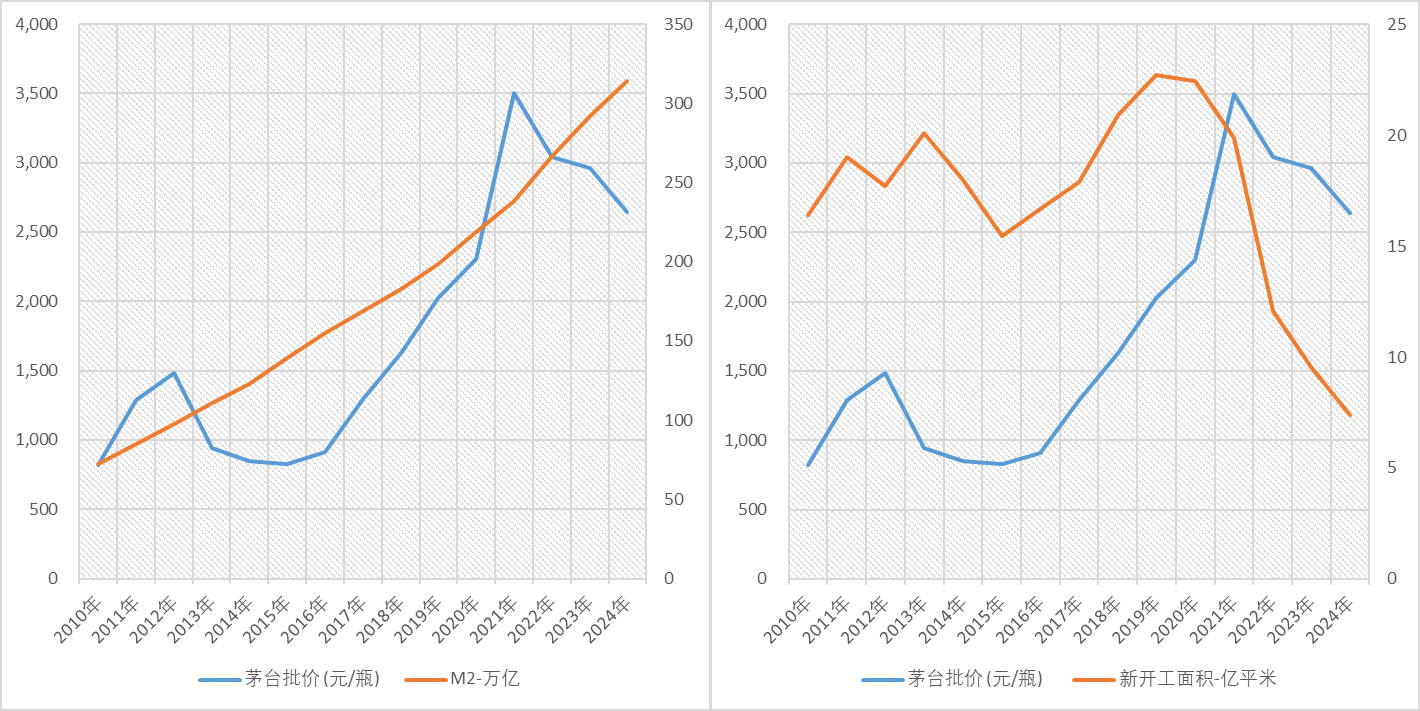
In our 2020 annual memorandum, we mentioned the high correlation between Moutai's batch prices over the past ten years and M2. However, for some time since the beginning of 21 years, this correlation seems to have diverged significantly. Let's review this relationship and focus on several inflection points:
Figure 6. Trend of Moutai Liquor Batch Price and M2, New Real Estate Construction Area
Data sources: Wind Database, Nomura Research Institute
1. In 2012, the price of Moutai collapsed. On November 19, 2012, a plasticizer scandal broke out in Jiugui Liquor. In December of the same year, a ban on consumption by three public companies was introduced. The former created a disturbance at the level of public opinion, while the latter directly led to a steep jump in demand. At that time, government consumption accounted for half or more of the overall consumption of the liquor industry. The introduction of the three public consumption bans has made the government consumption scene disappear.
2. In 2015, the wholesale price of Moutai recovered significantly and began to accelerate after that. In June 2015, the shantytown renovation policy was introduced, including a large amount of funds such as government, banks and social capital entering the real estate market. Moutai prices have also continued to rise with the efforts of real estate and infrastructure.
3. In 2021, the batch price of Moutai peaked and began to decline slowly. Moutai, which has accompanied the rise in infrastructure, has also fallen back to this day following data such as construction area, house prices, and stock market.
We can see that the price trend of Moutai is affected by many factors, closely related to infrastructure, real estate industry indicators, and money supply growth rate, and also has a certain correlation with the price trend of domestic core assets (housing market, stock market):
Infrastructure and real estate industry indicators have the most significant correlation with Moutai prices.This is actually easy to understand. Business banquets are frequent in these industries. Moutai is a "just-needed" banquet for high-end banquets, and its demand is highly linked to the number of new houses started and the availability of funds. For example, from 2015 to 2020, the shed reform pushed up house prices, the Moutai consumer group expanded, and the price increase was highly synchronized with the growth rate of house prices.
The growth rate of M2 money supply also has an impact on the price of Moutai.It reflects the actual purchasing power of the market and will stimulate high-end consumption including Moutai when the growth rate is fast. However, this correlation will weaken significantly after 2021.
Moutai is related to the price trend of core assets and has strong financial attributes.For example, in 2021, Moutai liquor prices, housing prices in core cities, and stock indexes peaked and fell back.
Based on these analyses, we believe that the dilemma facing Moutai today may not be as simple as a cyclical correction. At the 2024 summit, Ding Xiongjun, then chairman of Kweichow Moutai Company, mentioned in his speech "Promoting the Sustainable Development of China Liquor through" Aesthetic "Practice" that the problems facing the liquor industry are not cyclical, but contemporary. The speech at the beginning of this chapter is actually followed by a paragraph.
Changes in the times have brought new challenges, but they also breed new opportunities. Therefore, this era is a new era for China's liquor industry, and we also call it the "Beauty Era."
In the face of the great changes of the times, Moutai chose to take the initiative. The management stated that "three transformations" should be carried out, including customer base transformation focusing on "new business" groups, scenario transformation and service transformation. We appreciate this transformation with a very strategic vision. However, when paradigm changes come, the risks and uncertainties of enterprises cannot be measured using the previous model in the steady-state environment. Sunac, Evergrande, and Haikang may need to drink countless Moutai to create hundreds of billions of yuan in revenue, but how many bottles of Moutai will Douyin, Xiaomi, Deepseek, and Tencent consume in the process of creating 1 trillion yuan in revenue? At this stage, Moutai's ex-factory price is still some way away from the batch price/market price, but when the market is still linearly extrapolating the future development of Moutai based on the logic of rising volume and price, we have to be very careful.
(Risk warning: Moutai prices collapse.)
9. Midea Group
"From Shunde, China to the global layout of R & D, production and sales. Looking back at a quarter-century, no matter how big a storm is, it will be just an ordinary breath in the long run. We must maintain our fighting spirit, dare to think and act, dare to change and fight hard, be determined to make global breakthroughs, bravely push open the door of the world, grow in all places we know, and go to every corner of the world to find distance."
- "Midea Group 2024 Annual Report", Fang Hongbo
In 2024, Midea is moving forward amid changes and its performance has hit a record high. Its total operating income will reach 409.1 billion yuan, a year-on-year increase of 9.4%, and its parent net profit will reach 38.5 billion yuan, a year-on-year increase of 14.3%. Under the situation of increasing external pressure and increasing internal difficulties (the domestic air-conditioning market will decline by 2.2% year-on-year in 2024, and small kitchen appliances will remain flat year-on-year), it is not easy for Midea to continue to achieve surpassing results.
In 2024, Midea's own brands have achieved market breakthroughs in many countries and multiple home appliance categories. For example, Midea's refrigerator products have achieved first market share in Malaysia, Saudi Arabia, Chile and other countries, and have increased to market share in Vietnam, Thailand and other countries. Second place; Midea's washing machine products have reached first and second place in Malaysia and Saudi Arabia respectively; the market share of household air conditioning products has ranked first in Brazil and Egypt for many consecutive years.
Midea's way to escape the gravity of the real estate industry and break through is to use its own advantages to unswervingly expand new growth points:
With the "COLMO+ Toshiba" dual high-end brand strategy, the overall retail sales of dual high-end brands increased by more than 45% year-on-year during the same period;
Overseas private brand e-commerce sales revenue increased by more than 50% year-on-year;
Overseas business accounted for 41% overall, and revenue increased by 12.01% year-on-year, a record high.
These increases came after Midea paid a dividend of 26 billion yuan last year. After sharing nearly 70% of its net profit, the company was still able to explore many emerging businesses and achieve double-digit growth! We appreciate the company's strong performance orientation, hard-working management culture and leading talent echelon construction. This may also be the most fundamental driving force and source of its continued development for many years. Although the pressure brought by the continued decline in real estate, uncertainty in Sino-US trade, and the strong rise of Xiaomi cannot be ignored, Midea has demonstrated good evolutionary capabilities and long-term doctrine in management and emerging businesses.
We will continue to track and evaluate the development of Midea in old and new fields.
Due to space, other concerned companies (META, Meituan, China Merchants Bank, Ping An of China, Vanke, Longhu, Focus Media, etc.) will not discuss this time. They are all the most competitive and promising players in the industry or market segment.
Special note: Highly leveraged financial and real estate companies are essentially different from the aforementioned Tencent and Dianduo. As long as the latter leaves a sufficient margin of safety, the probability of long-term losses is extremely low. However, the former may lose a large amount or even lose all principal.
X. Summary
"Bad companies will be destroyed by crises, good companies will survive crises, and great companies will evolve due to crises."
- Andy Grove, former CEO of Intel
Every time technology rises and falls, every conflict and crisis, companies will fall and companies will rise. In an environment of low prices, in the storm of global trade, and under the changes of subversive technology, how to break through and traverse is a very challenging test for every investor.
In the next ten, thirty and fifty years, there will definitely be a series of various shocks. But historical experience shows that the world and industry are always spiraling. Electric cars, once a plaything of the rich, are now becoming increasingly affordable. Batteries, which account for 40% of car costs, have dropped by 90% since 2010.
At present, the international public opinion field is full of arguments about global economic differentiation ("East rises and West falls","East stabilizes and West swings", etc.) and intensified geopolitical conflicts. Some viewpoints worry that the international order will return to the "Law of the Jungle" era of the jungle "where the weak are strong. However, the real jungle is not simply a jungle dominated by the weak, but is based on extensive cooperation. Countless animals, plants, fungi and bacteria exhibit symbiotic and altruistic phenomena. For example, up to 80% of land plants rely on symbiotic relationships with fungi, and nearly 90% of vascular plants also have symbiotic relationships with microorganisms.Cooperation and collaboration are the true laws of the jungle, is the underlying logic that supports the long-term evolution of nature.
As a practitioner of value investment, I always believe that truly great companies should be able to be rooted in the local market to form irreplaceable competitive advantages, and also transform this advantage into the common wealth of global consumers. At this moment, I see that the dynamic soil of China is nurturing such a commercial miracle. Companies that continue to innovate on new energy vehicle tracks, technology pioneers who are reshaping the industrial landscape in the wave of artificial intelligence, and consumer platforms that improve life efficiency through digital innovation. These companies not only have a vast domestic demand market consisting of 1.4 billion people as a "thick snow", but also demonstrate the ambition to upgrade "Made in China" to "Made in the World", which is exactly what investors dream of."Long slope". Their abundant cash flow and continued ability to evolve will support them to move forward amid changes. After all, the essence of investment we recognize is to find great companies that can continue to create value, and then grow with these down-to-earth companies.
This memorandum ends here. We feel very fortunate to thank investors for their long-term support, because it has strengthened the cornerstone of our courage to adhere to long-term doctrine. I also thank readers for taking their precious time to read such a nagging pile of words. If you have any questions, suggestions or criticisms about any content in the memorandum, please send an email to eugene_tu @ belaircapital.com.cn. Thank you so much.
(Special note: The above analysis is only used as an exchange of methods for studying industries and companies in the past year, and does not constitute a recommendation for buying or selling stocks of companies such as Tencent Holdings and Pinduo. For companies we have followed in the past year or years, we cannot confirm that we will continue to follow under any circumstances in the future.)
Bel Air Asset Management Co., Ltd. Tu Shiyang
2025/04/23
 Guangdong public network security no. 44000000000000


